
Context
This week, I spent my time developing and producing our one-hour sports radio show, The Bench Warmers. The aim was to create an engaging sports broadcast that combined current sporting news, presenter-led discussions, music and professional radio production techniques.
The show is aimed at an audience aged 13–45, with no particular gender skew. The target audience consists of people who are generally interested in sports news and sporting personalities.
Throughout the production process, I worked on researching current sporting stories, writing presenter links, developing the running order, recording my voice tracks in the studio and assembling the programme using professional radio playout software.
Research
Research played an important role in developing the content for The Bench Warmers. I needed to identify relevant sporting stories that would interest my target audience and provide enough information to create engaging presenter links.
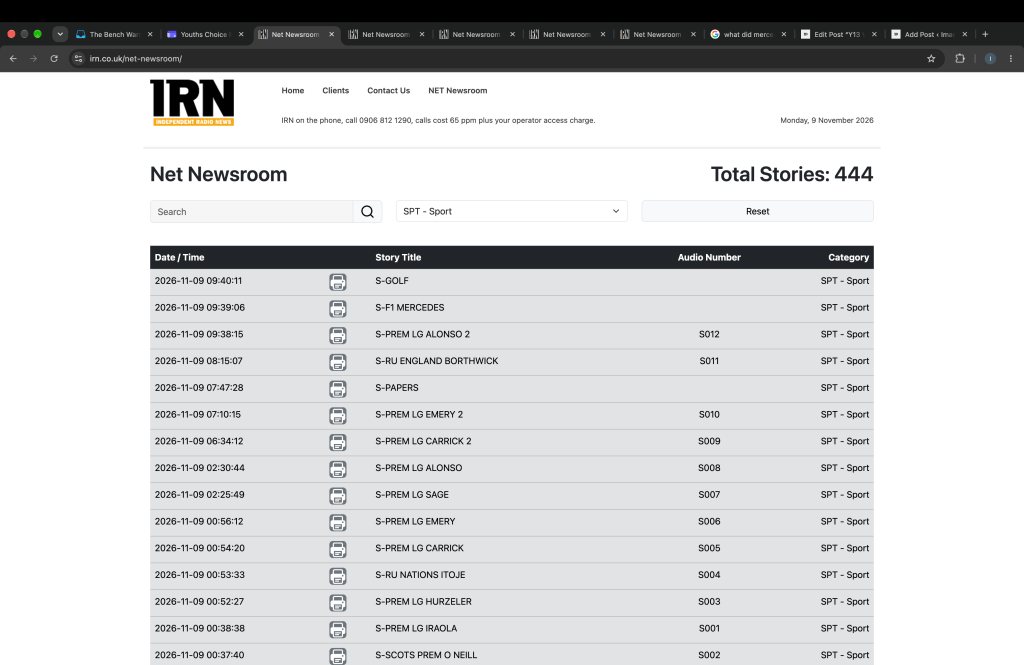
One of the main resources I used was IRN Net Newsroom. This provided access to current news stories and audio content across different categories, including sport. I used the SPT – Sport category to identify relevant stories and gather information that could be incorporated into the programme.
Using IRN Net Newsroom allowed me to access professionally prepared news material and identify stories that were suitable for broadcast. It also helped me understand how professional radio newsrooms organise and distribute content to broadcasters.
I then used this research to develop my own presenter links rather than simply reading information directly from the news source. This allowed me to communicate the stories in a more conversational and engaging way.
Technical
For this production, I used a combination of Adobe Audition 2026, IRN Net Newsroom and Zetta to create and assemble the radio programme. I began by recording my presenter links in the studio using Adobe Audition 2026. This allowed me to capture my voice tracks separately so that I could edit and prepare them before incorporating them into the final running order.
Recording in the studio gave me greater control over the quality of my audio. It also allowed me to focus on my vocal delivery, pacing and clarity without having to worry about the technical aspects of live broadcasting.
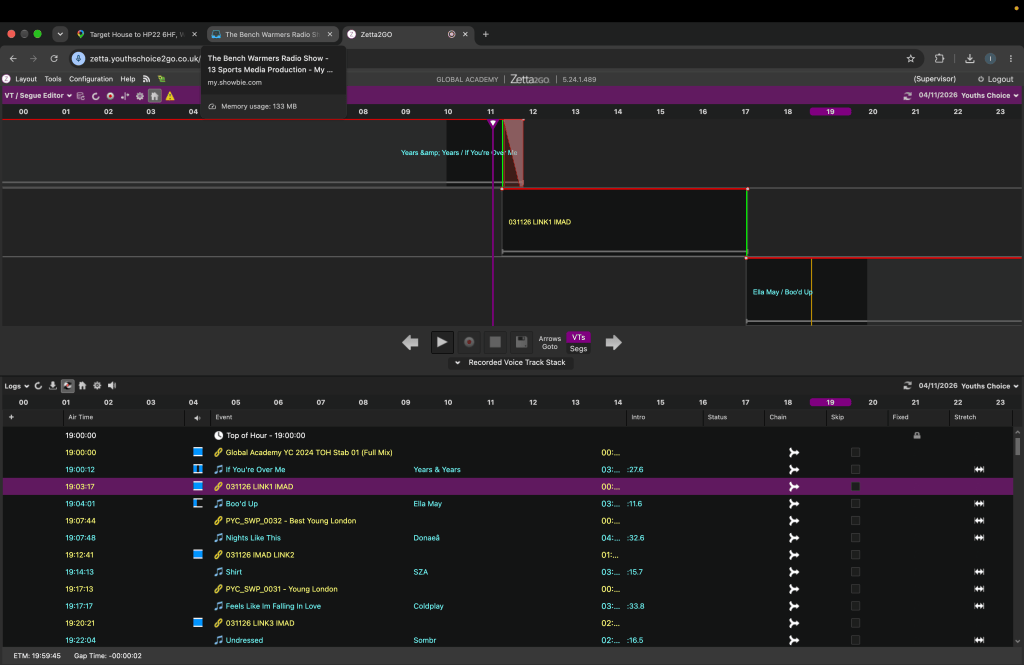
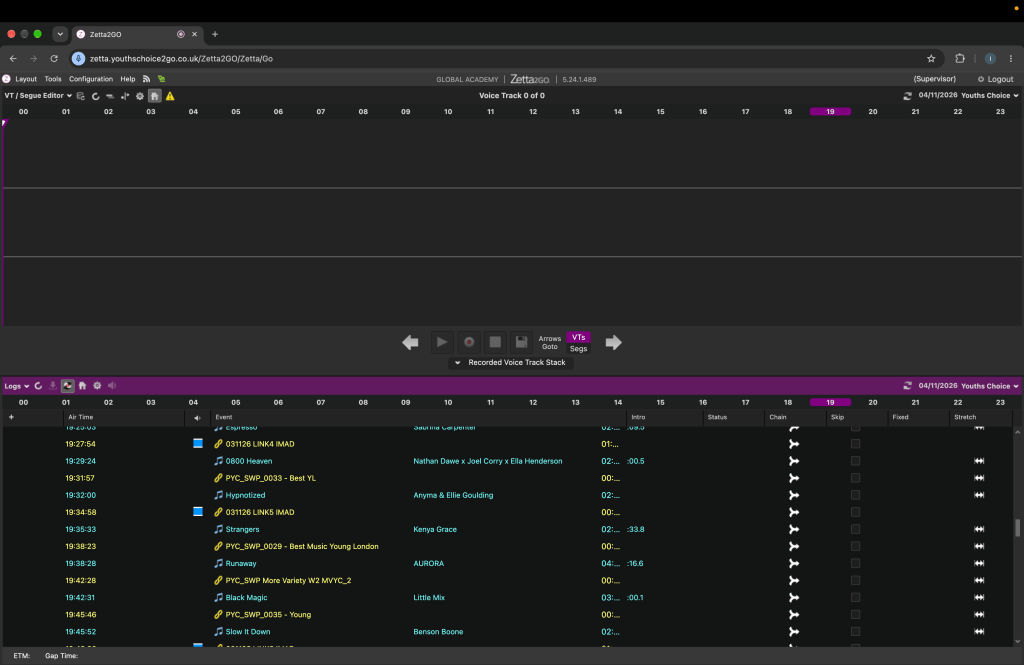
Zetta allowed me to position my voice tracks alongside the music and other audio elements in the running order. I could see the scheduled broadcast times, the duration of individual items and how the different elements fitted together.
One particularly important feature was the VT / Segue Editor. This allowed me to visualise how my recorded voice tracks interacted with the music. I could see where my links started and finished in relation to the songs, helping me understand how transitions would work during playback.
I also used the playlist and scheduling interface to organise the programme. This included positioning my recorded links between tracks and checking the sequence of items throughout the hour.
Using Zetta helped me develop my understanding of professional radio playout systems. Rather than simply placing audio files in a basic editing timeline, I was working with a system designed to manage the scheduling and playback of a radio broadcast.
Story
The main purpose of The Bench Warmers was to deliver a one-hour sports radio programme that informed and entertained its audience.
I wanted the programme to cover relevant sporting developments while giving listeners a reason to remain engaged throughout the broadcast.
My presenter links were written around specific sporting stories, allowing me to introduce subjects, provide additional context and transition between different sections of the show.
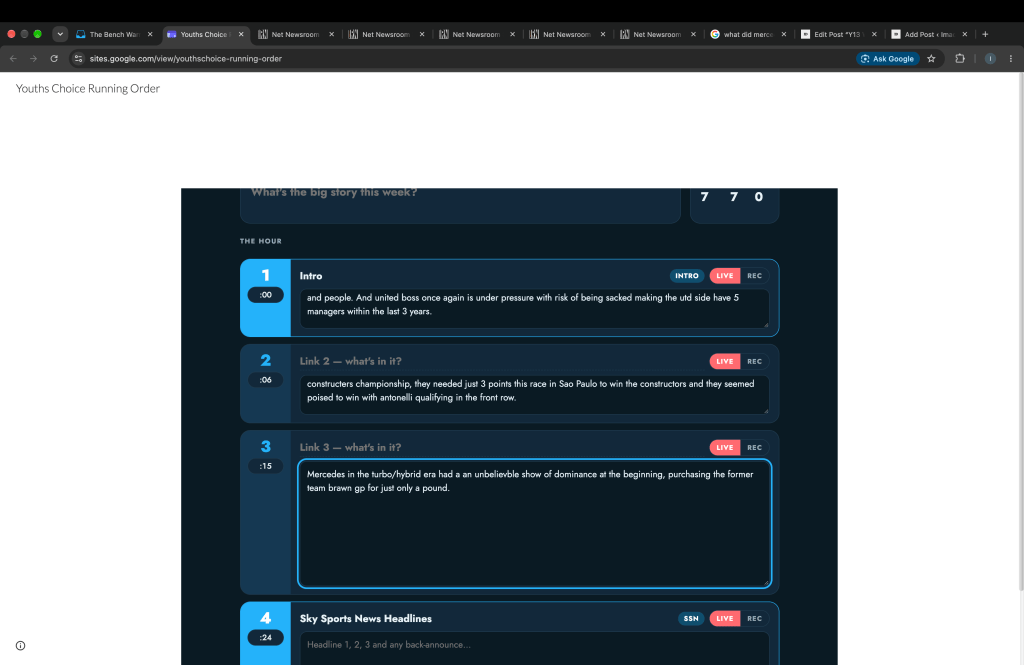
I also explored the history of Mercedes in Formula 1, looking at its dominance during the turbo-hybrid era and the acquisition of Brawn GP. This provided an opportunity to give listeners some historical context rather than concentrating entirely on the latest results.
Alongside Formula 1, I included football stories, particularly developments surrounding Manchester United. This provided variety and ensured that the programme was not focused on just one sport.
I also incorporated music into the running order to create a more relaxed listening experience between the sports content. The intention was to avoid making the programme feel like a continuous news bulletin and instead create something that felt like a complete radio entertainment product.
Stylistic
Stylistically, I wanted The Bench Warmers to have the feel of a modern sports radio show. The majority of my inspiration was taken from talksport and their radio link and the way it is orginised.
I aimed to combine the informative approach of sports news broadcasting with the more conversational and energetic delivery associated with entertainment radio.
The running order was also important in establishing the programme’s identity. I used a mixture of presenter links, music, station sweepers and news content to create variation throughout the hour.
The music selection was deliberately varied, featuring artists from different genres. This helped broaden the programme’s appeal to the 13–45 target audience and provided a contrast to the more information-heavy sports segments.
I also considered the transitions between different elements of the show. Using Zetta’s segue functionality allowed me to visualise how the presenter links and music would interact, helping create a smoother listening experience.
Problem Solving
Problem: Finding relevant and reliable sporting stories for the programme.
Solution: I used IRN Net Newsroom to access professionally prepared sporting news and identify stories that were relevant to my target audience. I then used this information to develop my own presenter links, ensuring the content was suitable for the programme.
Problem: Making sure my presenter links fitted naturally into the running order.
Solution: I recorded my links separately in Adobe Audition and then loaded them into Zetta2GO. This allowed me to position them between songs and other programme elements while checking their timings and transitions.
Problem: Understanding how the different audio elements would work together during playback.
Solution: I used the VT / Segue Editor in Zetta to visualise the relationship between my voice tracks and the music. This helped me understand where transitions occurred and how the different elements would sound when played consecutively.
Evaluation and Reflection
What Went Well (WWW)
One of the main successes this week was developing my understanding of the complete radio production process. Rather than concentrating on just recording presenter links, I was involved in the research, scripting, recording and playout stages of producing a one-hour programme.
I particularly enjoyed using IRN Net Newsroom to research sporting stories. It gave me an insight into how professional radio organisations source and distribute news content. I was able to use this research to develop my own scripts and select stories that were relevant to my target audience.
Another positive was my use of Adobe Audition 2026 to record my presenter links in the studio. This allowed me to develop my confidence behind the microphone and consider the importance of vocal delivery, timing and clarity when presenting sports content.
Even Better If (EBI)
One area I could improve is the depth and variety of my sporting research. Although I covered relevant stories, I could explore a wider range of sports to ensure that the programme appeals to as much of my target audience as possible. Including subjects such as basketball, tennis and other major sporting events could help broaden the programme’s appeal.
I could also improve my scripting by developing stronger introductions and conclusions for each presenter link. This would help make the transitions between stories feel more natural and give each segment a clearer purpose.
Another area for improvement would be developing my vocal delivery. Although recording in the studio allowed me to concentrate on my presentation, I could experiment further with pacing, emphasis and tone to make my delivery sound more confident and engaging.


