
Proposal
Candidate Name – Imad Daili
Candidate Number – 9014
Pathway – Level 3 Sports Media
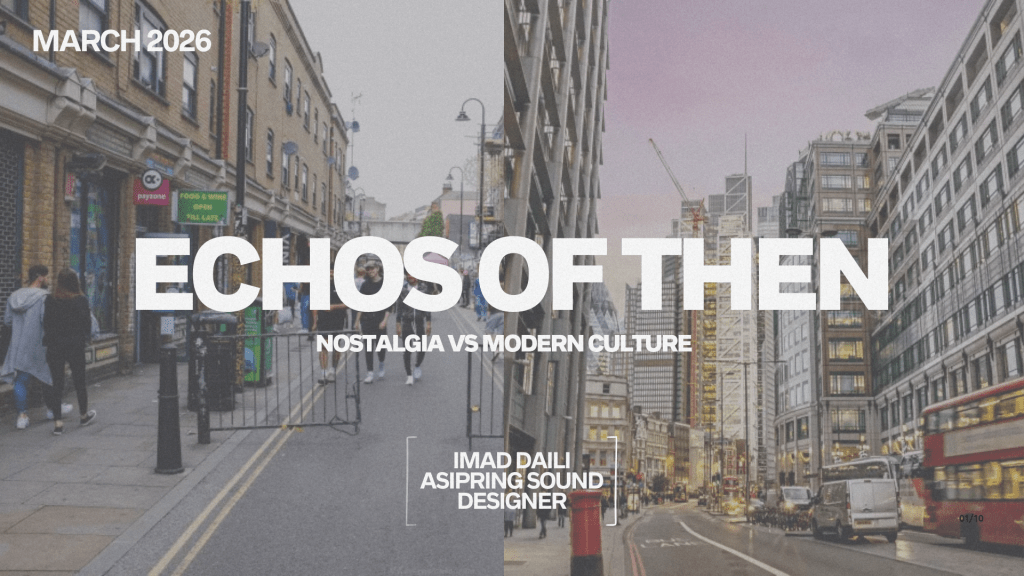
Project Title: Echoes of Then
Rationale
I am passionate about this project because I am seriously interested in how media and culture from the past shape and continue to influence the activities of today. Growing up surrounded by early 2000s content, mainly music, fashion and digital trends. I have developed a strong awareness of how nostalgia shapes identity and audience behaviour today. This project allows me to explore a connection in a creative way. To this project I bring relevant experience and skills through my work editing the Back in the Dayz podcast with Stevo the Madman. My experience created my own audio documentary series, “The Playbook”, as well. This has developed my technical ability in audio editing in Adobe Audition, as well as understanding my ability with pacing, storytelling and audience engagement. This project is highly relevant to my career aspirations as a sound designer. The ability to research, structure narratives and produce engaging audio is essential. This project will help me develop those skills at a higher level. Preparing me for future academic and professional futures.
Project Concept
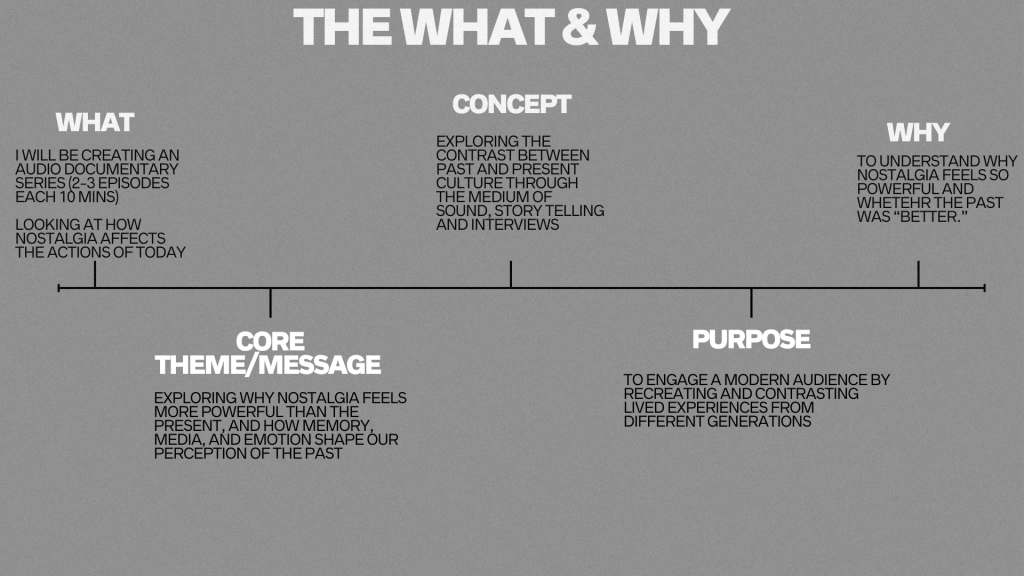
This project will contain a series of 2-3 audio documentaries, each of them around 8-10 mins in length, exploring the theme of “Nostalgia vs Today: How the past shapes the present.” Each episode will focus on a specific aspect of early 2000s culture, such as music, fashion or digital life, and identify how these elements continue to influence modern society. The documentaries will follow a clear and structured narrative, beginning with an engaging audio introduction, followed by an exploration of the past, and concluding with an analysis of their cultural impact. This approach will allow for both informative and immersive storytelling.
To support the development of this project, I will take on both primary and secondary research. My primary will include conducting interviews with notable people, such as the executive producer of the Back in the Dayz podcast and potentially StevoTheMadman himself. Secondary research will involve analysing existing audio documentaries, articles and online sources to ensure accuracy and depth.
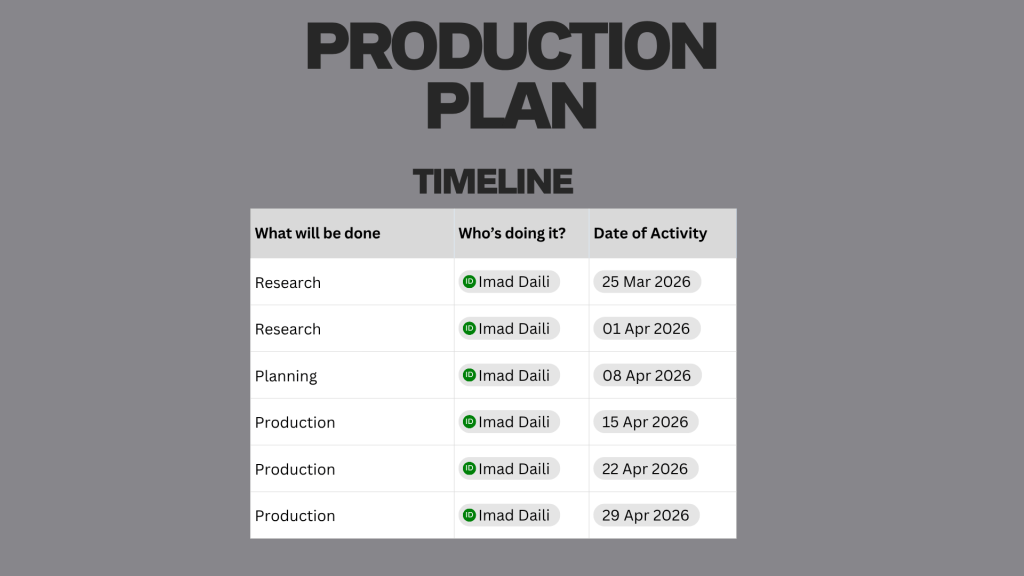
The target audience will be individuals aged 15-35, as they are most likely to engage with the theme of nostalgia and contemporary culture. The project will be produced using a MacBook Pro M2 and edited all using Adobe Audition; this will incorporate recorded interviews, narration, archival audio and sound effects. Key stages include research, script writing, focus group feedback, recording and editing. The aim is to create a high-quality, engaging audio documentary series that demonstrates strong storytelling, technical skill and audience awareness.
Evaluation
The way I will reflect and evaluate my work is by creating weekly logs detailing what I have done that week, ending it off with 3 things that went well and 3 things that I could improve on. I will document my changes week by week, explaining what has been improved and what could be improved. I will ensure that my project is targeted to the right audience; it will be mentioned in the context, and the rest of the log will constantly link back to the context, detailing how I have reached my target audience effectively.
Bibliography
Adobe creates your own podcast.
National Life Stories – British Library (no date).
Ofcom. 2025. Audio listening in the UK.
Spotify for Creators – Supercharge your podcast discovery on social media.
Ofcom – Top podcast listening trends from our research
Ofcom – Top trends from our latest look at the UK’s listening habits
Ofcom – Audio listening in the UK
Pitch Deck
BIF Document
‘Echoes of Then’ is an idea to contextualise nostalgia and understand why it matters today and how it changes the virtual landscape, culture and so much more.
Echoes of Then is an audio-based documentary split into 3 parts looking at nostalgic figures of the past, mainly focusing on my experience and my input on the “Back in the Dayz Podcast” with Stevo the Madman. It will look at 3 different parts, being “Why do we miss the past?” “How it is being repackaged today” and “Is it really helping culture or keeping it stuck?”
Main Idea
My project looks at how nostalgia, memory and past media continue to influence today’s culture, particularly through podcasting and controversial storytelling. The project is mainly derived from my experience with the Back in the Dayz podcast, which gives both a practical and authentic context. Similar work has been done through nostalgia-led podcasts, which have had a very positive impact on the people of today. Also, documentary series have been made on the same topic. My project builds on the same style but applies it in my own series and research focus.
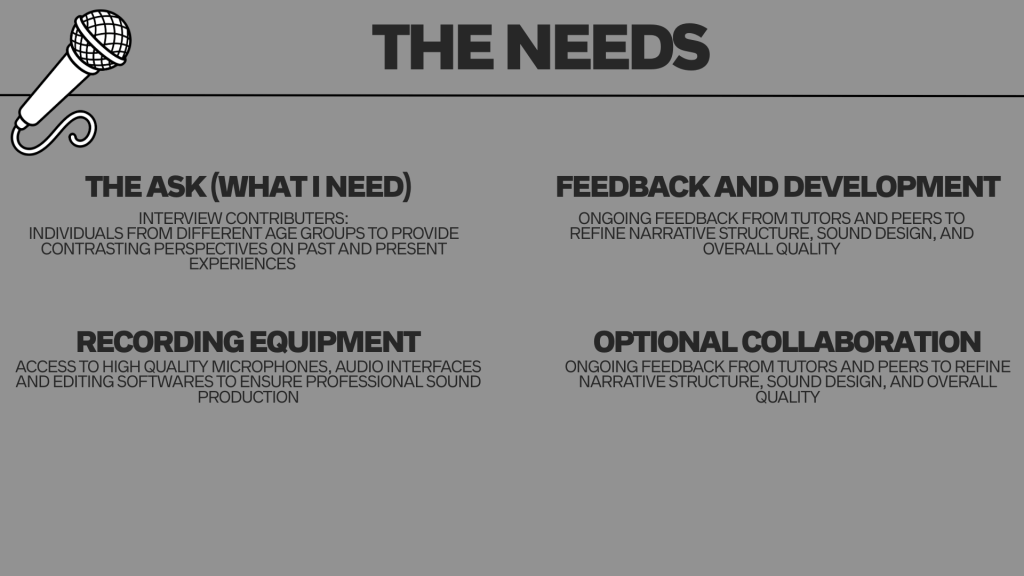
However, to make the project work, there could be a number of practical problems; time is one of the key challenges, as I have to research, plan, record and evaluate a 3-part audio series within the deadline. I do need to also work around the availability of contributors, particularly anyone connected to Back in the Dayz, as interviews and recorded discussions depend on when people are free. Equipment is another factor, as I am mainly working with the recording and editing sources that are available to me.
The project will concentrate on audio storytelling, podcast culture and reflections on past entertainment, lifestyle and shared experiences. This means the project will include interviews and scripted narration. But it will not attempt to cover every area of nostalgia in full detail. For example, it will not become a general history project or a broad study of media forms; instead, it will stay focused on the relationships between memory, cultural reflection and modern audio media.
Backstory
Nostalgia-led media has already been used successfully in podcasting and documentary storytelling. A key influence of this project is, as said previously, the Back in the Dayz podcast, which uses memory, humour and cultural references to create conversations around shared experiences. This shows that nostalgia can work as more than a theme; it can become a storytelling tool that encourages the audience to reflect on their own past. Further more Giles Petersons Worldwide (BBC Radio 6 Music) presents Black British music through one core presenting voice.
Target Audience
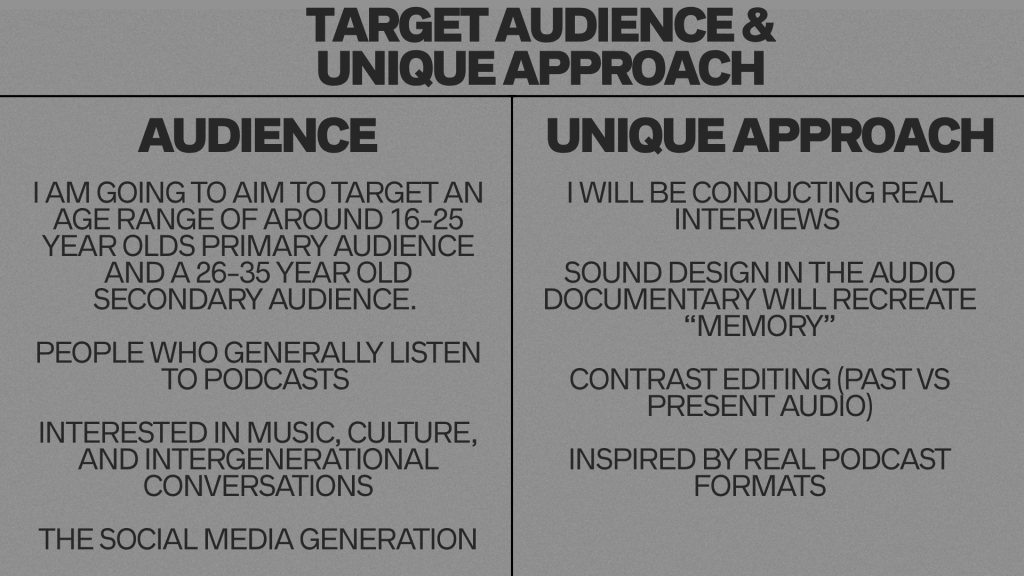
My core target audience will be a younger age range of 16-25 years old with a secondary audience of 26-35 years old; however, it will be skewed to a younger audience with a strong interest in media, music, podcast culture and intergenerational conversations. This audience will likely be active in the digital world and aware of the culture around them. This is because, as said prior, this series is heavily linked to Back in The Dayz around “How things used to be.”
Assumptions
The current assumption of the project is that I will have access to the audio equipment and editing software and the recording spaces necessary. I am also assuming the contributors and the interviewees will be available at a suitable time.
Oppurtunity
The opportunity within the project is to explore nostalgia in a way that feels personal, youthful and culturally relevant, while still being analytical. A lot of nostalgia content simply celebrates the past for its former glories; however, my project will answer why the past still feels so powerful in today’s age. This gives me the chance to produce a documentary series that is emotional, reflective and critical at the same time.
Scope
The scope of my documentary will largley be looking behind the activities of the Back in the dayz podcast. This is also coupled with the different sub cultures within the british scene such as UK Garage, jungle and grime.
Project focus
The project will focus mainly on UK youth nostalgia, podcast culture, music, digital culture and shared media memories from the late 1990s, 2000s and early 2010s. It will not attempt to cover the full history of nostalgia or every form of media. The final outcome will be a three-part audio documentary series, with each episode focusing on a different angle: why we miss the past, how the past is repackaged, and whether nostalgia helps culture move forward or keeps it stuck.
Constraints
The main constraints are time, access, copyright and production quality. Because this is a three-part audio series, I need to manage scripting, recording, editing and evaluation within the FMP deadline. Access to contributors may also be limited because interviews depend on their availability. Copyright is another limitation, meaning I will need to avoid using uncleared music or archive clips unless I have permission or use short, properly justified examples. Technically, I also need to make sure the recordings remain clean and consistent, especially if any interviews are recorded in different spaces.
Success
Success will be measured through the quality of the final pieces and the evidence that they connect with the intended audience. On a production level too, success would mean creating a well-structured, organised and good quality of sound. Success can also be measured in listens, feedback and engagement. Furthermore, through my own weekly logs, I can also improve on whatever I write that I need to improve on.
Deliverables
The final deliverables of the project will be a 3-part audio documentary series, with each episode forming one part of the overall project. Alongside the finished audio pieces, I will also need to hand in the supporting production work, including research, planning documents, scripts or structures, recorded interviews where relevant, weekly logs and final evaluation of the project. By the deadline I should have completed all 3 episodes, all being supported by pre-production materials.
 Imad Daili - Sports Media