
In this part of my FMP I will be including the proccess of my FMP and what I have used to complete it. I will be attaching all of the versions of my final product. Different ideas I had and all relevant screenshots into the process of what I have done. At the end of this page will be the very final product(s)
Pre Production
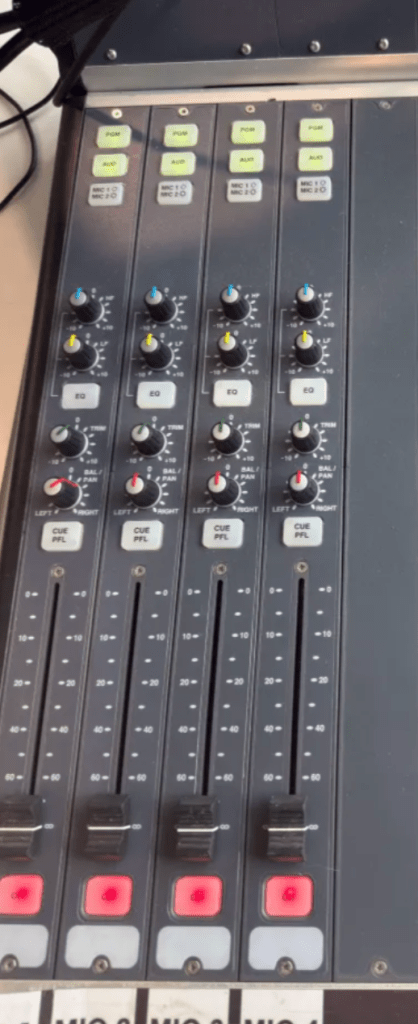
Before starting any of my recordings I have ensured that my microphone was not alterted with in anyway with, In the image below I was using mic 2 with the trim turned a little bit up, this ensured a great turn out.
Production Schedule
| What will be done | Who’s doing it? | Date of Activity |
| Scripting | Imad Daili | 15th April 2026 |
| Scripting | Imad Daili | 22nd April 2026 |
| Recording | Imad Daili | 29th April 2026 |
| Editing | Imad Daili | 30th Apr 2026 |
| Editing | Imad Daili | 7th May 2026 |
| Release | Imad Daili | 8-12th May 2026 |
Recording Enviorment
I was recording in a sound proofed enviorment with sound proofing on the wall. Furthermore, the windows are angled to ensure that the sound does not bounce back and cause an echo. The mic that we used was the Audio Technica AT2020 with a muff over it. I kept it at least 6 inches away from me while recording as well to ensure high quality audio that does not peak.
FULL SCRIPT – EPISODE ONE
OPENING
VO:
There is something strange about the past.
Sometimes all it takes is one sound.
One phrase.
One old song.
One memory you did not even know was still there.
And suddenly, for a moment, you are somewhere else.
Back in a classroom.
Back in a front room.
Back in a car journey.
Back in a version of life that felt smaller, simpler, funnier… maybe even safer.
That is the power of nostalgia.
It can take something ordinary and make it feel important.
It can turn a sound into a memory.
A memory into a feeling.
And a feeling into something you carry for years.
VO:
But why does that happen?
Why do we miss the past so much?
Why do old moments stay with us?
And why does nostalgia still have such a strong grip on the media we consume today?
VO:
This is Echoes of Then a documentary series exploring how nostalgia and memory continue to shape media, audiences and culture today.
And in this first episode, I am looking at one question:
Why do we miss the past?
SECTION 1 THE FEELING OF NOSTALGIA
VO:
Nostalgia is often spoken about like it is just remembering.
An old TV show.
A childhood game.
A phrase people used to say.
A tune that instantly takes you back.
But nostalgia is more than memory.
It is memory mixed with emotion.
That is what makes it different.
Because people are not always going back to the past because the past was perfect.
A lot of the time, they are going back because of how it felt.
The feeling of being younger.
The feeling of being around family.
The feeling of laughing with friends.
The feeling of a time before life became more complicated.
And that is why nostalgia matters.
It is not always accurate.
It is not always logical.
But it is deeply personal.
Sometimes what people miss is not even the actual moment.
It is the version of themselves that existed inside that moment.
VO:
And I think that is one of the reasons nostalgia still works so strongly today.
Because modern life moves quickly.
Content moves quickly.
Trends move quickly.
People are constantly expected to keep up with what is new.
So when something reminds you of what you already know, what you already felt, what you already loved it cuts through.
It feels familiar.
And familiar things are powerful.
SECTION 2 WHY THIS TOPIC BECAME IMPORTANT TO ME
VO:
For me, this topic became more interesting the more I worked around Back in the Dayz.
Back in the Dayz, hosted by Stevo the Madman, is a podcast built around memory, reflection and shared cultural experience.
At the centre of it is a very simple idea: looking back.
Looking back at the shows people watched.
The music they grew up with.
The games they played.
The school memories they still laugh about.
The cultural moments that shaped them without them fully realising it at the time.
And from being involved around that environment, I started to notice something.
Nostalgia is not just something people feel quietly by themselves.
It is something that can shape a whole conversation.
It can shift the tone in a room.
It can make people open up.
It can make them laugh quicker, remember more clearly, interrupt each other, build on each other’s stories.
A guest may arrive as a guest.
But the moment a real memory comes up, the conversation changes.
It becomes warmer.
Less guarded.
More alive.
And that made me realise that nostalgia is not just a theme.
It is a trigger.
A trigger for honesty.
A trigger for humour.
A trigger for connection.
SECTION 3 BEHIND THE SCENES OF BACK IN THE DAYZ
VO:
What is interesting about being involved with a nostalgia-led podcast is seeing how much of its strength comes from the details.
On the surface, Back in the Dayz sounds like a conversation.
And it is.
But behind that, there is also something more deliberate happening.
Certain references instantly unlock stories.
A mention of an old TV programme can open ten minutes of discussion.
A school memory can make the whole room react.
A throwback tune or childhood phrase can completely change the energy.
And those moments matter because they do more than entertain.
They create recognition.
People listening are not just hearing somebody else’s memory.
They are measuring it against their own.
Did I watch that too?
Did I hear that as well?
Did I say that?
Did I grow up around that?
That is where nostalgia becomes powerful as media.
Because it stops being just a story from one person.
It becomes a shared cultural memory.
And I have learned that this is one of the reasons Back in the Dayz works.
Yes, the guests matter.
Yes, the personality matters.
But what really gives the content weight is that it constantly gives the audience moments to attach themselves to.
Not just listen.
Attach.
SECTION 4 WHY AUDIO IS SUCH A GOOD FORMAT FOR NOSTALGIA
VO:Audio is especially powerful for this kind of content.
When you remove visuals, people listen differently.
They focus on tone more.
On pauses.
On laughter.
On how a memory is told rather than just what the memory is.
And because there is no picture showing everything, the listener starts building the scene in their own mind.
That makes nostalgia in audio feel personal.
You hear a story, and your imagination fills in the rest.
You hear someone describe a classroom, and suddenly you are back in yours.
You hear someone mention a programme, and your mind pulls up your own version of that memory.
You hear laughter around an old cultural reference, and even if the exact moment was not yours, the feeling still becomes familiar.
That is part of what makes podcasts and audio documentaries such a strong place for nostalgia to live.
They do not just present the past.
They let you hear it.
And in hearing it, you begin to feel your own version of it too.
This section was removed as it did not fit the correct mood of the episode. And it made the episode too lengthy and was not applicible to the episode.
SECTION 5 INTRODUCING THE EXEC PRODUCER INTERVIEW
VO:
To understand that more clearly, I wanted to speak to someone who has seen this process from the production side.
Someone who understands not only how nostalgia feels, but how nostalgia works as content.
So I spoke to the executive producer of Back in the Dayz.
INTERVIEW SECTION
INTERVIEW QUESTION 1:
What do you think it is about nostalgia that makes people connect to it so strongly?
INTERVIEW QUESTION 2:
When Back in the Dayz was being developed, was nostalgia always the centre of the concept?
INTERVIEW QUESTION 3:
What kind of topics or references tend to get the biggest reaction from guests and from the audience?
INTERVIEW QUESTION 4:
Do you think nostalgia works differently for younger audiences who may not have lived through every reference first-hand?
INTERVIEW QUESTION 5:
From a production point of view, why does nostalgia-led content work so well in audio?
I only selected the answer from the first question as the answer I recieved was good and long enough for my audience to gain an insight as to what everything was about.
SECTION 6 WHAT I HAVE LEARNED FROM THIS CASE STUDY
VO:
The biggest thing I have learned from looking at Back in the Dayz is that nostalgia-led content works best when it does not feel manufactured.
It has to feel natural.
It has to feel lived in.
It has to sound like people are not just remembering for the sake of it, but remembering because those moments still mean something.
That is what I want to carry into Echoes of Then.
Not just the topic of nostalgia, but the tone of it.
The warmth of it.
The honesty of it.
The small references that make people stop and smile because they know exactly what is being talked about.
I have also learned that nostalgia gives people two things at once.
It gives them entertainment.
But it also gives them belonging.
And that is powerful.
Because when someone hears a cultural reference they understand, they are not just hearing content.
They are hearing confirmation that they were part of something too.
That is why I think nostalgia remains so effective in modern media.
It creates community out of memory.
SECTION 7 WHY THIS MATTERS FOR MY AUDIENCE
VO:
For my audience, that matters a lot.
A younger, digitally active audience does not just want content that looks polished.
They want content that feels real.
They are used to hearing podcasts.
Watching clips.
Seeing old trends brought back.
Seeing past eras recycled through music, fashion and internet culture.
So a documentary like Echoes of Then has to do more than explain nostalgia.
It has to sound like it understands why people are drawn to it.
That means the style needs to stay engaging.
The tone needs to feel conversational.
The sound design needs to support the mood without overwhelming it.
And the stories need to feel human enough for the audience to see themselves inside them.
That is one of the clearest lessons I have taken from this first episode.
Nostalgia is not just about looking backwards.
It is about how the past continues to live in present-day culture — and how media keeps finding new ways to bring it back.
ENDING
VO:
So why do we miss the past?
Maybe because memory is emotional.
Maybe because familiar things make us feel grounded.
Maybe because certain parts of life only become meaningful once they are gone.
Or maybe it is because the past gives us something that the present often struggles to give us consistently.
A sense of connection.
What I have learned through this first episode is that nostalgia is not weak, irrelevant or accidental.
It is powerful.
It is cultural.
And when it is handled properly, it becomes more than remembrance.
It becomes media.
In the next episode of Echoes of Then, I will be looking at how media industries actively package and sell nostalgia and why the past has become such a valuable creative tool in the present.
EP 1 Practical Skills
During the making of EP 1 for the intro I was struggling to select a sound track for the introduction of the documentary, for context I wanted to envoke a feeling of warmth, nostalgia and much more.
What I did was run a focus group to assist me in selecting the one that fit best as they are all nice.
Below are the 3 options I had and we ended up with option 2.
Below are screenshots of the editing process within episode one from start to finish, including my FX of the vocal chain which goes as follows.
- DeNoise – Around 5-10% to remove any underlying background nosie
- DeEsser – This is to remove any sharp S’s sound effects that I might have made
- Parametric EQ – This is to level out my vocals to have a clean tone and make it feel more intimate.
- Dynamics Processing – Using the classic soft knee preset and editing it slightly to have a more dense vocal.
- Multi Band compressor – Using this to compress specifc frequencies of my vocals specifically giving me more accurarcy.
- Hard Limiter – The hard limiter limits the peaks of my audio ensuring no peaks
- Matching Loudness – I matched the loudness to -16 LUFS as that is the general broadcast form for streaming platforms.
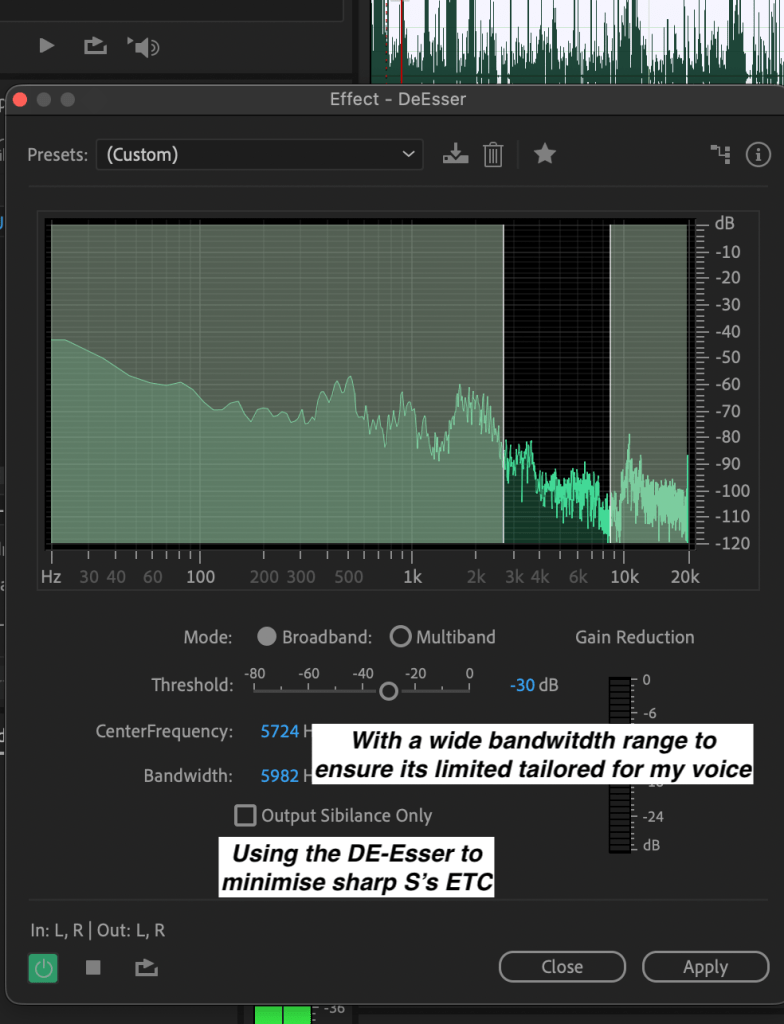
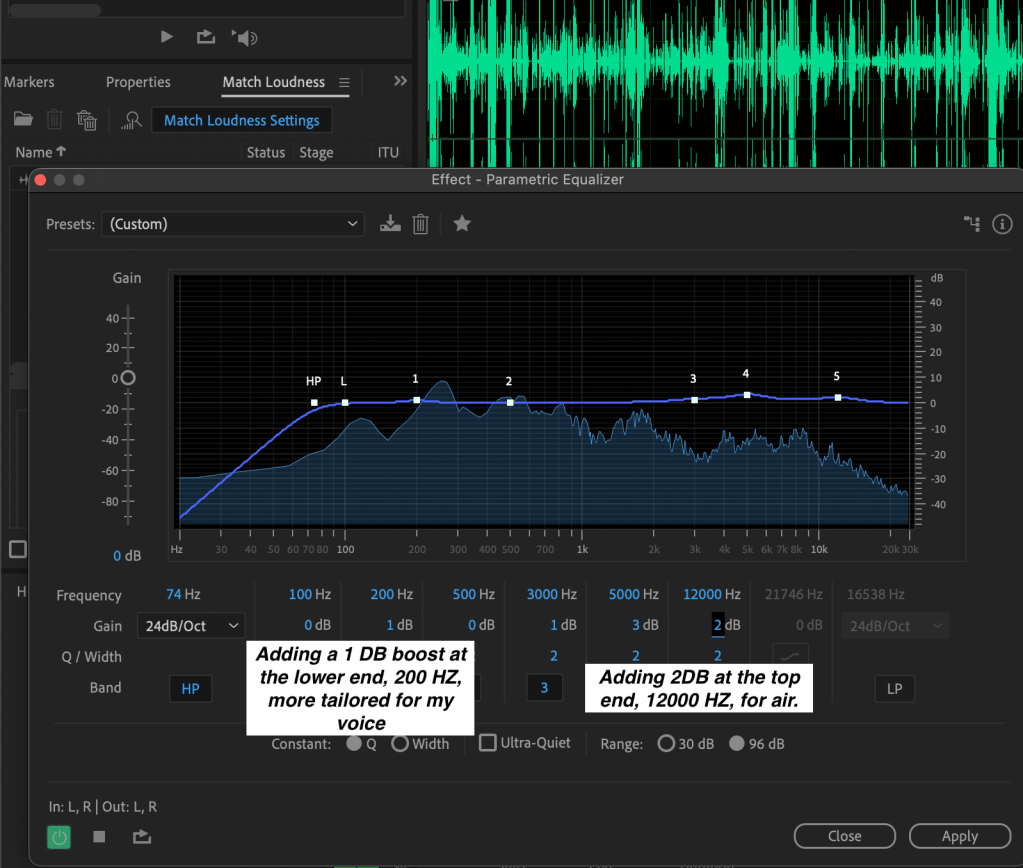
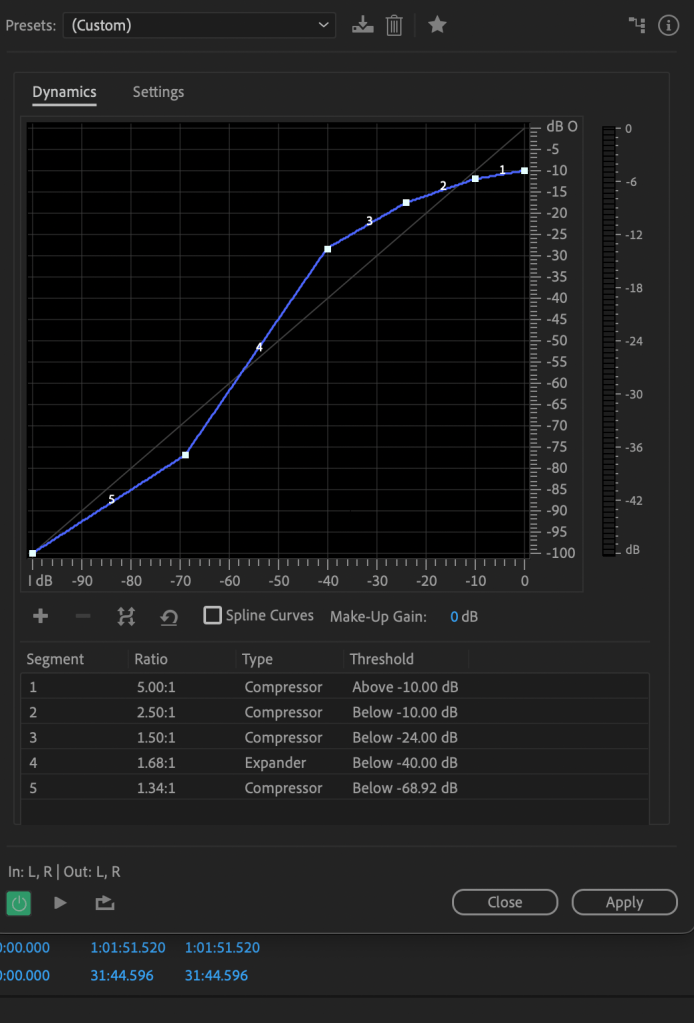
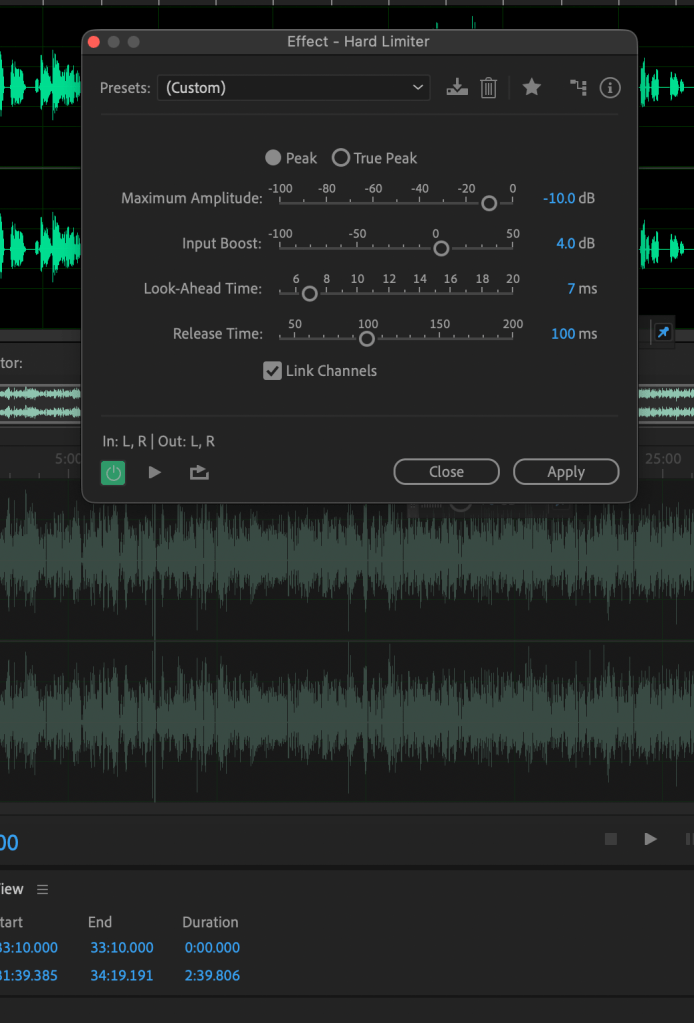
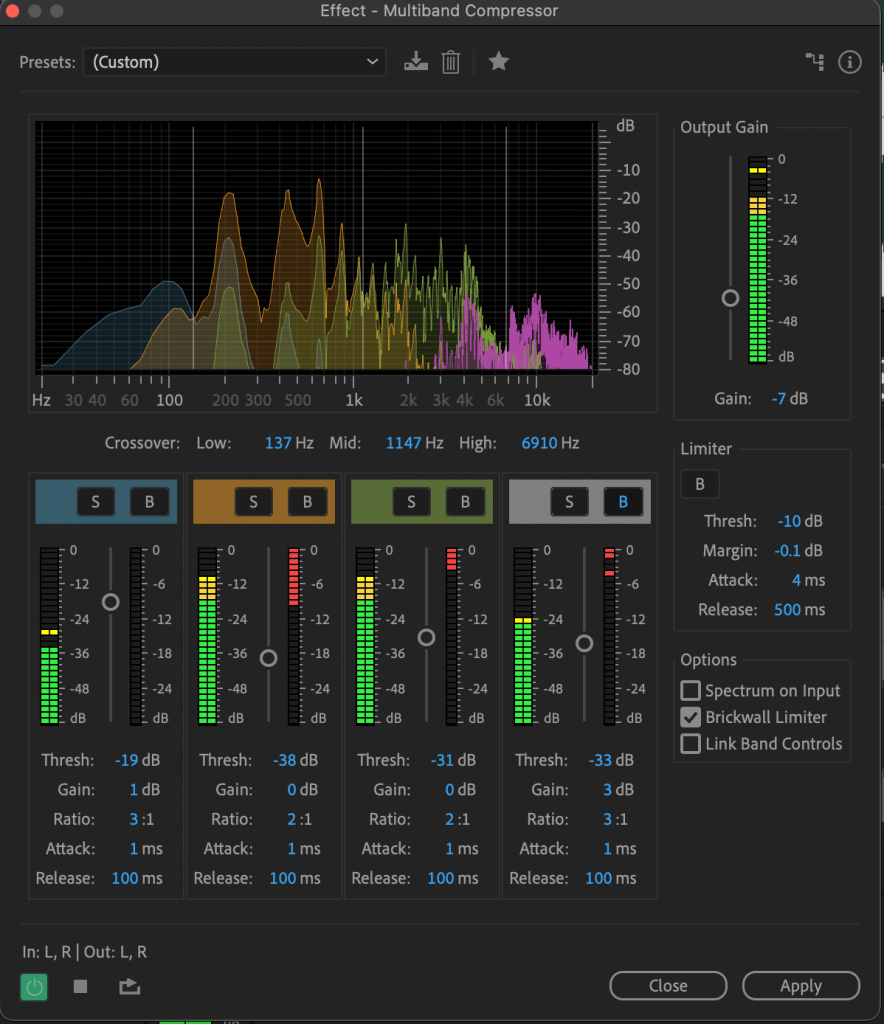
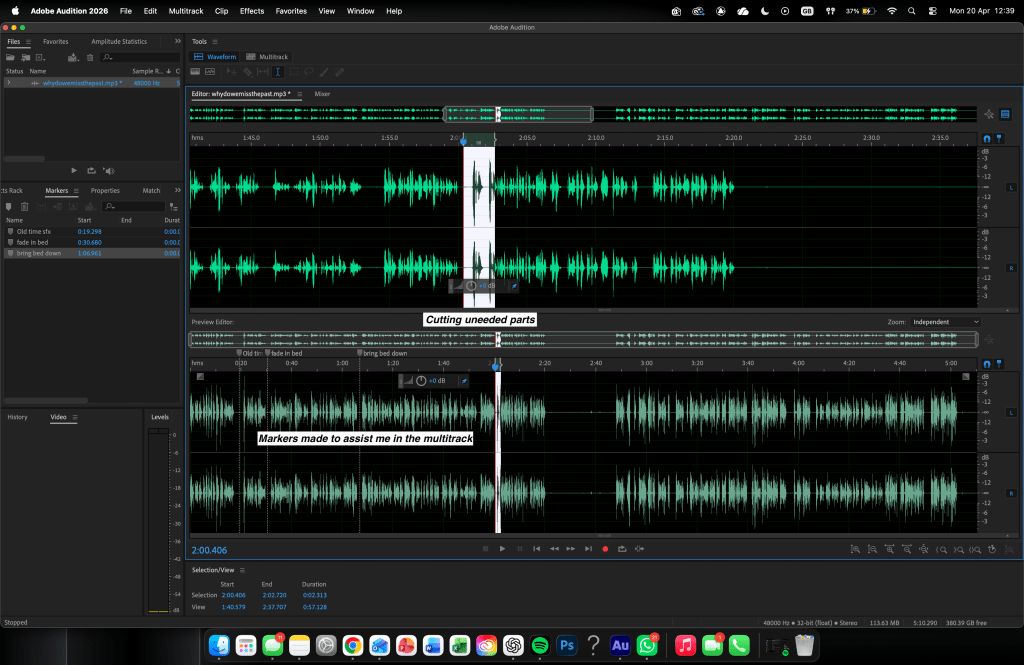
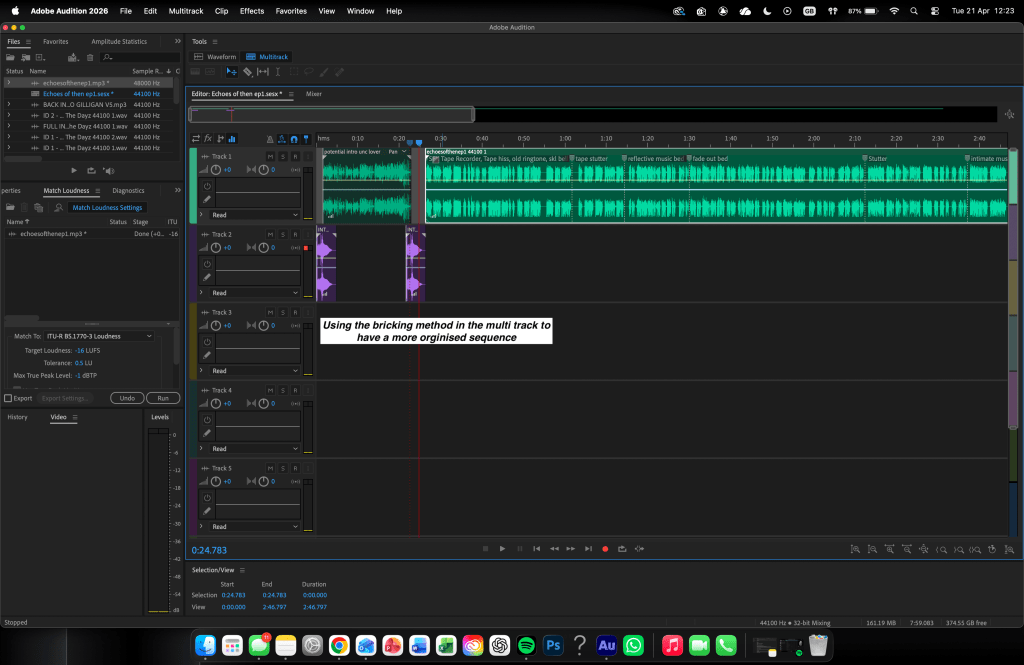
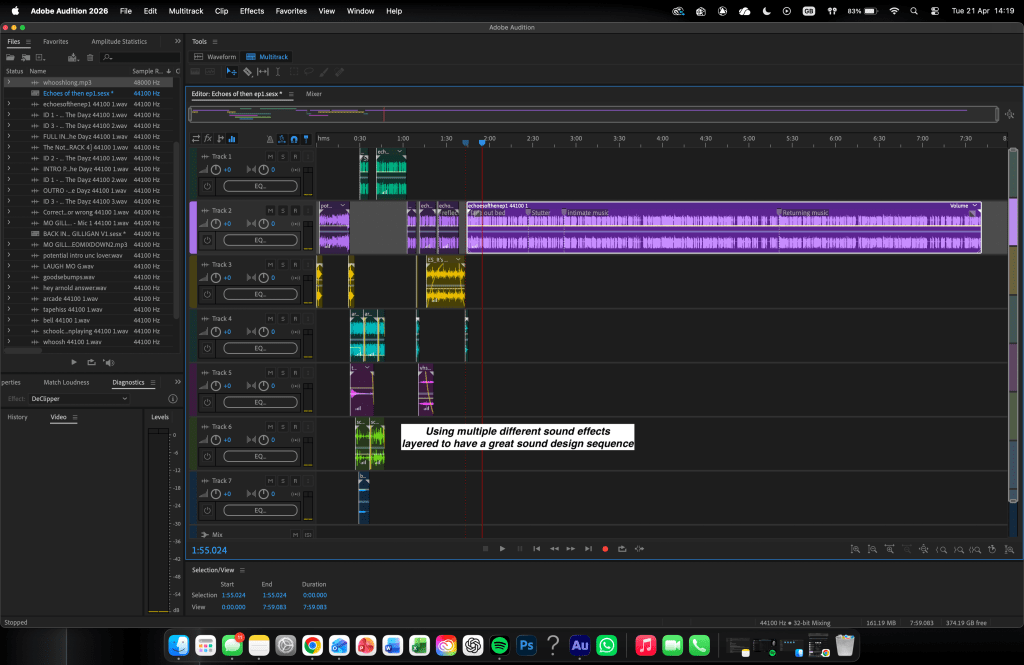
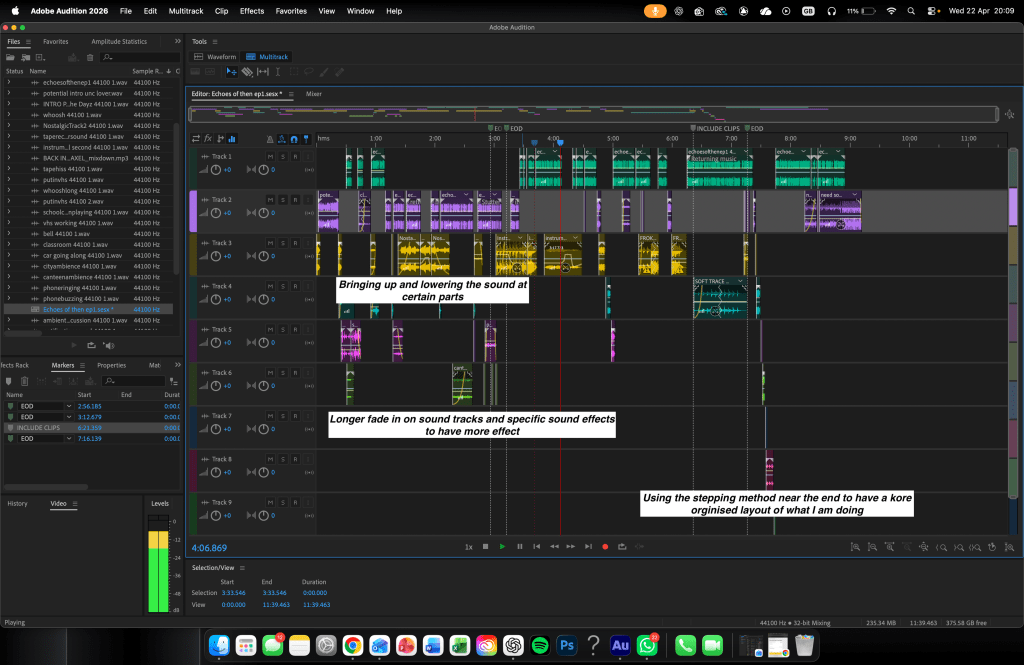
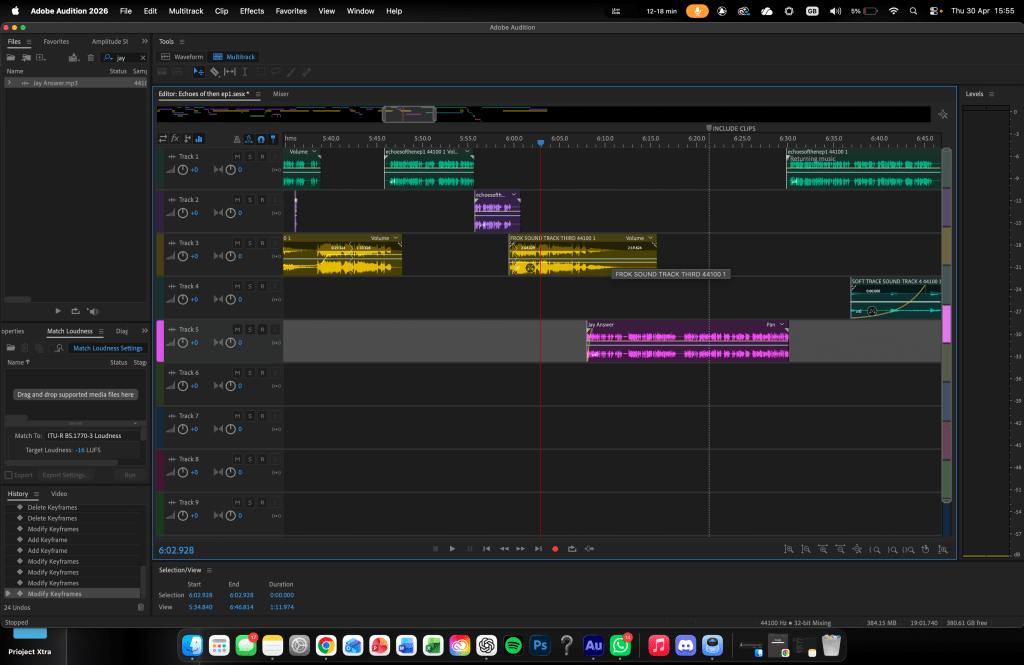
During the editing of the episode I also used a wide variety of sound fx mainly found from epidemic sounds and a list of them are below. Then it will be followed by different music beds.
During the editing process as well my recording did come off too loud so I reduced the volume all the way down to -6 DB and also using the match loudness setting after the final mix down, a before and after screenshot is shown and this was done for all of the SFX I used to maintain consistency.
Sound FX
- School Bell SFX
- Children Playing out SFX
- Tape Hiss SFX
- Putting in a VHS Tape SFX
- Another Variation of a VHS working
- Another Variation of a VHS working
- Another variation of putting in a VHS tape
- A long WHOOSH SFX
- Notification sounds
- Canteen Ambience SFX
- Car driving along/City sounds SFX
- City Ambience SFX
- Classroom SFX
- Phone Notification Buzzing SFX
- Phone Ringing SFX
- Ambient Discussion SFX
ALL OF THE SFX ARE NOW AVAILBLE TO PLAY BELOW IN THE SAME ORDER AS ABOVE.
Now below is a list of the music beds that I found. I will list them then attach the mp3. These are copyright free from Epidemic Sounds
- Nostalgic Track 2
- Second Instrumental
- FROK Third Sound Track
- Soft Trace Sound Track
- I am better off Jazz Sound Track – Outro
ALL OF THE SOUND TRACKS ARE NOW AVAILBLE TO PLAY BELOW IN THE SAME ORDER AS ABOVE.
Originally the outro contained 21 Seconds by So Solid Crew however spotify blocked it due to copyright concerns.
Finally here is a list of all my found footage audio.
- In my feelings – Drake – “KIKI DO YOU LOVE ME…”
- Crazy Loom Advert – Loombands
- Manequin Challenge Soundtrack
ALL OF THE SOUND TRACKS ARE NOW AVAILBLE TO PLAY BELOW IN THE SAME ORDER AS ABOVE.
Below is the final product of episode one which has been platformed on Spotify and apple podcasts.
Echoes of Then EP 2 – Repacking the past
For this episode the story for the documentary series goes as follows.
EP 1 – Explains the feeling itself as a whole.
Ep 2 – Explores the media packaging of the emotion.
Ep 3 – Explore the impact.
As we are on the second installment I want to stray away from the calmer tone that was contained within EP 1 explainging the feeling. As now we are looking at the business side of the feeling and how it can be repackaged as a media asset to generate monetary profit it should be sharper, direct, brutal in a sense. In its dictation and it’s sound design too.
Full Script EP2 – Repackaging the past
VO:
Listen to that.
The tape click.
The rewind.
The static.
The old-school textures.
The little signals meant to drag your mind somewhere familiar before I have even really said anything.
That is not accidental.
That is part of it.
Even this episode this one, right now is using the language of nostalgia to talk about nostalgia.
The sound effects.
The references.
The atmosphere.
The borrowed signals from older media.
It is all repackaging.
And that is the point.
Because the past does not just return on its own anymore.
It is summoned.
Built.
Edited.
Layered back into the present until it feels natural to have it here again.
VO:
In Episode 1, I looked at why we miss the past.
Why nostalgia feels warm.
Why memory sticks.
Why people keep going back.
But warmth is never where this ends.
Because the second a feeling proves it can hold attention, somebody finds a way to use it.
And once that happens, it stops being just memory.
It becomes material.
VO:
This is Echoes of Then.
And this is Repackaging the Past.
⸻
SECTION 1
VO:
The past is not just “coming back.”
That phrase sounds soft.
Passive.
Almost innocent.
Like old things are just drifting naturally into the present.
They are not.
They are being brought back.
Chosen.
Positioned.
Reframed.
Old songs reappear because somebody knows the sound is already loaded with meaning.
Old formats return because familiarity lowers the risk.
Old visuals come back because they arrive with built-in atmosphere.
Old references get recycled because recognition is faster than explanation.
That is what repackaging is.
Not memory.
Use.
VO:
And the reason it works is brutal in its simplicity.
The familiar gets less resistance.
People do not need time to understand it.
They do not need to be convinced from zero.
They do not need to learn a completely new emotional language.
The work has already been done.
Years ago.
Sometimes decades ago.
All media has to do now is reactivate it.
⸻
SECTION 2 — THE FALSE COMFORT OF FAMILIARITY
VO:
That is what makes nostalgia so effective.
It creates a false sense of safety.
Not because it is fake.
But because it feels settled.
Known.
Tested.
Already survived.
A memory does not arrive like a risk.
It arrives like a return.
And that changes everything.
Because once something feels like a return, people stop treating it like a sales pitch.
They stop seeing the framing.
They stop noticing the mechanics.
They think they are just reconnecting.
But reconnection can be product too.
That is the trick.
Not forcing the past on people.
Making them feel relieved to see it.
VO:
That is why nostalgia rarely enters through the front door.
It slips in through tone.
Texture.
Mood.
A phrase.
A sound.
A detail that disarms you before the structure underneath it becomes visible.
And by the time you clock what is happening, you are already inside it.
⸻
SECTION 3
VO:
And that includes this episode.
The rewind effects.
The tape hiss.
The static hits.
The analogue feel.
These are not neutral choices.
They are loaded.
They point backwards.
They suggest memory.
They imply archive.
They create age, wear, distance, recovery.
They make the episode feel like it is pulling something out of storage.
That is aesthetic packaging.
That is emotional framing.
And if I am being honest, it works.
Because the second you hear a rewind, your brain starts doing extra work for me.
It starts filling in time.
Distance.
History.
Meaning.
I do not even have to say “this is about the past” in a straightforward way.
The sound already said it.
That is how deep this goes.
Even when you are criticising repackaging, you can end up using its tools just to make the criticism land.
VO:
So no I am not standing outside of this.
I am inside it too.
And that matters.
Because nostalgia is not just something “the media” does somewhere far away.
It is a creative shortcut sitting within reach the second you want something to feel loaded, intimate or real.
⸻
SECTION 4
VO:
This is where the shift happens.
A memory, on its own, is unstable.
Messy.
Private.
Half-forgotten.
Contradictory.
Media does not like unstable things.
Media shapes them.
It takes something loose and turns it into structure.
A memory becomes a hook.
A hook becomes a clip.
A clip becomes a title.
A title becomes a promise.
A promise becomes a product.
That is not poetry.
That is process.
And once memory enters process, it changes.
Not always beyond recognition.
But enough.
Enough to travel.
Enough to hold attention.
Enough to become useful.
That is the word that keeps coming back.
Useful.
Because once the past becomes useful, it stops being left alone.
SECTION 5
VO:
That is what makes Back in the Dayz such a revealing example.
At its core, it is built around memory.
Reflection.
Recognition.
The energy of looking back and finding something still alive there.
And from being involved around it, what becomes obvious is not that the nostalgia is fake.
It is not.
It is that the nostalgia is functional.
That is different.
A conversation lands harder when a familiar reference unlocks the room.
A moment grows bigger when somebody remembers something specific enough that everyone else instantly joins in.
A story becomes more than a story when it starts pulling shared culture in behind it.
That is where the weight comes from.
Not from forcing the past into the conversation.
From knowing exactly how quickly the past can electrify one.
And once you see that happen enough times, you stop thinking of nostalgia as just mood.
You start recognising it as structure.
VO:
Some moments travel because they are true.
Some travel because they are funny.
And some travel because they trigger something old and collective at exactly the right time.
Those moments are gold.
Not in a sentimental sense.
In a media sense.
Because they carry reaction built into them.
SECTION 6
VO:
That is the part people do not always look at.
Selection.
Not every memory survives contact with media.
Not every recollection becomes content.
Not every moment makes the cut.
Some memories are too slow.
Too private.
Too shapeless.
Too difficult to package.
Others arrive ready-made.
Sharp enough to title.
Clean enough to clip.
Immediate enough to hit.
And that means what gets repackaged is never the whole past.
It is the most usable version of it.
The parts that move.
The parts that spark.
The parts that can be lifted, framed and sent back out.
So when media says it is “bringing the past back,” what it often means is this:
It is bringing back the parts of the past that perform best.
That is not the same thing.
Not even close.
SECTION 7
VO:
And once you see nostalgia this way, it becomes hard not to notice the larger pattern.
The machine likes what already worked.
Why build an entirely new emotional connection when an old one can be reactivated?
Why risk confusion when recognition is cheaper?
Why start from zero when memory gives you a head start?
That logic is everywhere.
And the more crowded media becomes, the more tempting that logic gets.
Because familiarity is efficient.
Efficient to market.
Efficient to package.
Efficient to circulate.
It carries less friction.
Which means the past keeps getting pulled back not just because people love it but because systems trust it.
And systems do not care about nostalgia the way people do.
Systems care about repeatability.
This was cut as the episode was lengthy enough and was mostly uneeded for the overall scope of the episode and seemed as if it was being repetitve.
VO:
That is where the atmosphere changes.
Because what began as comfort starts feeling closer to containment.
The same sounds.
The same references.
The same aesthetics.
The same loops dressed differently.
You get the illusion of return.
But underneath it, sometimes all you are really getting is repetition with better lighting.
SECTION 8
VO:
And this is where the question gets uglier.
What does repackaging cost?
Not financially.
Creatively.
If the past keeps arriving pre-approved…
If old things always come with more instant emotional value than new ones…
If references are doing half the heavy lifting before ideas even begin…
Then what happens to originality?
What happens to risk?
What happens to the things that do not come wrapped in recognition?
Because nostalgia can preserve culture.
Yes.
It can keep people connected.
Yes.
It can hold memory in public.
Yes.
But it can also flatten things.
Reduce a time into shorthand.
Turn real experiences into mood boards.
Strip mess into style.
Take life and sand it down until only the most marketable edges remain.
That is repackaging at its cleanest.
Not preserving the past.
Processing it.
SECTION 9
VO:
And there is no clean way out of this.
Because the tools work.
That is the uncomfortable part.
The tape hiss works.
The rewind works.
The old references work.
The glitch of analogue memory works.
They work on me.
They work in this episode.
They work because they still carry charge.
So this is not a takedown pretending to be pure.
It is a closer look at a system I am also using.
A recognition that once you understand the power of memory, it becomes incredibly hard not to shape with it.
That does not make every use of nostalgia cynical.
But it does mean every use of it deserves to be looked at properly.
Not just felt.
Examined.
ENDING
VO:
So no the past is not simply coming back.
It is being handled.
Broken down into pieces that travel well.
Given new framing.
Given fresh context.
Given just enough polish to pass as present tense.
And the most effective part of all?
It still feels like memory while it is happening.
That is why repackaging works.
It does not announce itself as manipulation.
It arrives disguised as recognition.
As warmth.
As culture.
As return.
My name is Imad Daili, and this is Echoes of then, Repackaging the past
Episode 2 – Practical Skills
During the making of episode 2 I went through multiple different variations of the episode changing minor details and also varying different soundtracks throughout to see what worked best. Below is all 3 variations that I made. And also altering different levels through the episode
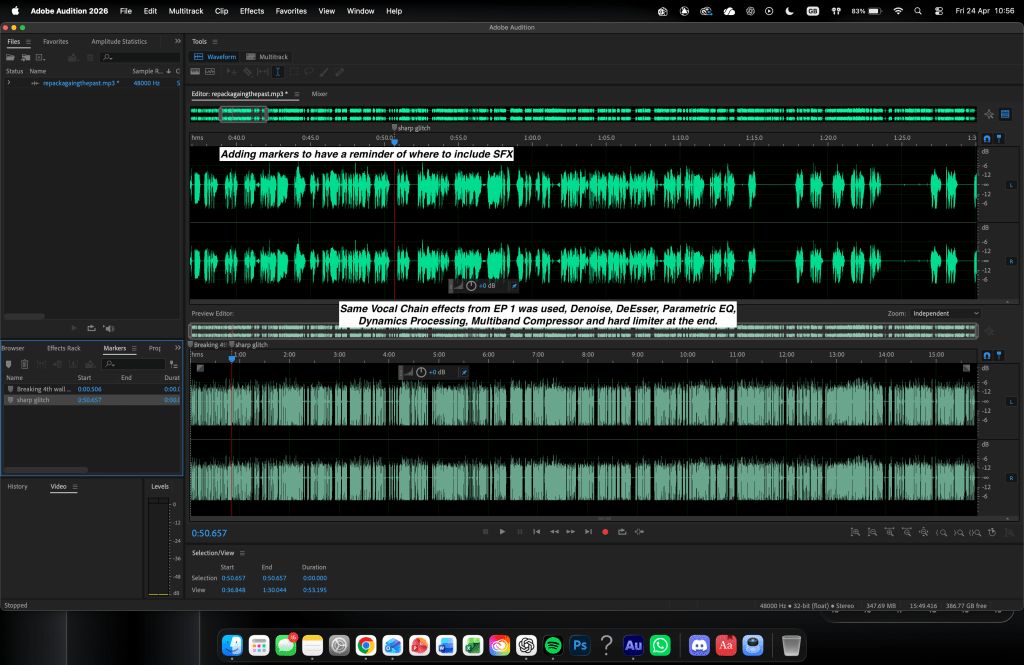
Below are screenshots of the editing process within episode two from start to finish I used the exact same vocal chain as episode one to maintain constiency throughout the episode.
- DeNoise – Around 5-10% to remove any underlying background nosie
- DeEsser – This is to remove any sharp S’s sound effects that I might have made
- Parametric EQ – This is to level out my vocals to have a clean tone and make it feel more intimate.
- Dynamics Processing – Using the classic soft knee preset and editing it slightly to have a more dense vocal.
- Multi Band compressor – Using this to compress specifc frequencies of my vocals specifically giving me more accurarcy.
- Hard Limiter – The hard limiter limits the peaks of my audio ensuring no peaks
- Matching Loudness – I matched the loudness to -16 LUFS as that is the general broadcast form for streaming platforms.
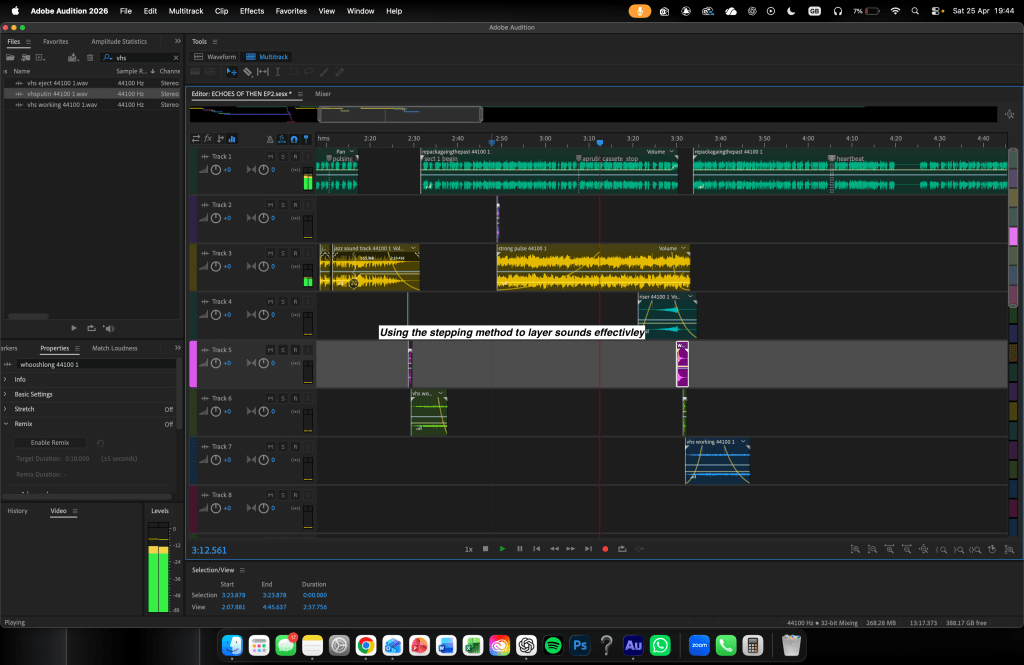
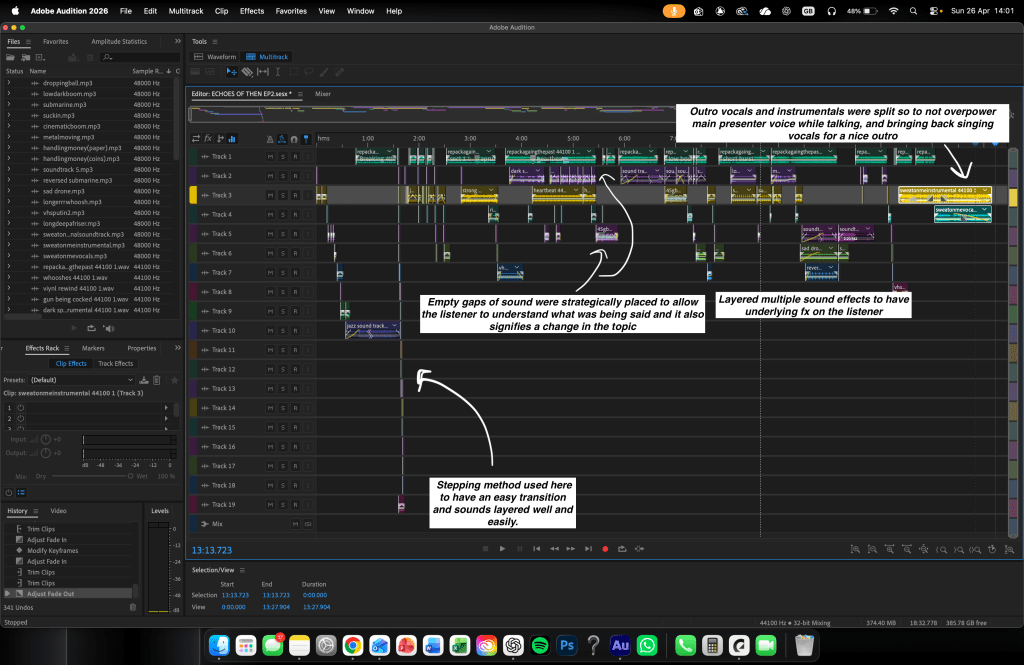
During the editing of the episode I also used a wide variety of sound fx mainly found from epidemic sounds and a list of them are below. Then it will be followed by different music beds.
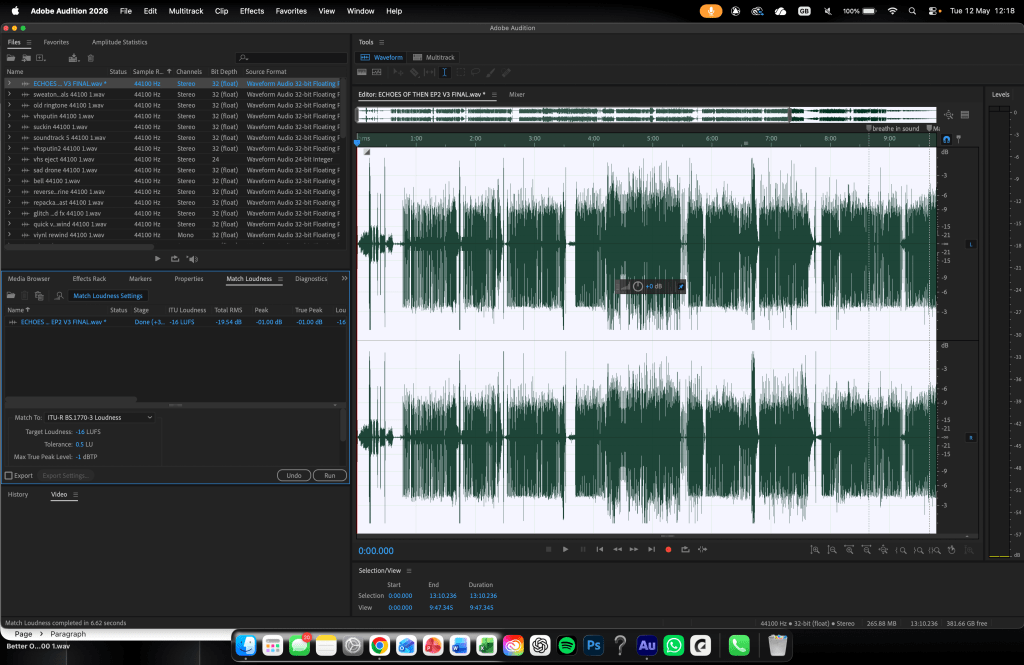
While editing as well my recording did come off too loud so I reduced the volume all the way down to -6 DB and also using the match loudness setting after the final mix down, a before and after screenshot is shown and this was done for all of the SFX I used to maintain consistency.
- School Bell
- Glitch SFX
- Gun being cocked SFX
- Old Ringtone SFX
- Quick Viynl Rewind SFX
- Riser 1 SFX
- Tape Click SFX
- VHS Eject SFX
- Another Variation of the Viynl Rewind
- Whoosh SFX
- 45 BPM Heart Beat SFX
- A cinematic BOOM sfx
- Riser 2 SFX
- Handling Money COINS
- Handling money PAPER
- Faster Heart beat SFX
- Long Riser SFX
- Long Whoosh SFX
- Low 808 Boom SFX
- Lower Dark 808 Boom SFX
- Metal scratching
- Reversed Submarine SFX
- Distanced Rewind
- Submarine SFX
- Suck in SFX
- VHS Put in 2
ALL OF THE SOUND TRACKS ARE NOW AVAILBLE TO PLAY BELOW IN THE SAME ORDER AS ABOVE.
I also used a different varitions of music beds as well and they go as follow
- Jazz Sound Track 1
- Dark Spacious Instrumental
- Sound Track 4 V2
- Sound Track 5
- Sweat On me INSTRUMENTAL
- SWEAT ON ME VOCALS
ALL OF THE SOUND TRACKS ARE NOW AVAILBLE TO PLAY BELOW IN THE SAME ORDER AS ABOVE.
Below is the final product of Episode 2 Platformed on spotify and apple podcasts
Episode 3 – Out of Time
In this episode of, Echoes of then, I wanted to try and incorparate some sports imagery within the episode, I wanted to bring back the emotions of episode one but retain the sharpness of episode 2.
I wanted to try and tell a story and make the audience realise that memory is just as important as the future.
The full script is shown below.
EP3 – Full Script
Intro
There’s something strange about timing.
You don’t notice it while you’re inside it.
When something is happening, you’re not analysing it. You’re not measuring it. You’re not stepping back and asking what it means. You’re just reacting. Moving through it. Keeping up with it.
But the moment it ends, everything changes.
You gain distance. And with that distance comes a kind of clarity that didn’t exist at the time.
That’s where nostalgia begins.
Not in the moment itself, but in the space that forms after it.
In Episode 1, I looked at why we miss the past.
In Episode 2, I showed how that feeling gets shaped and reused.
But neither of those matter unless you understand this properly:
Nostalgia is not memory.
It’s perspective.
And perspective only exists once you’re no longer inside the moment.
This is Echoes of Then.
And this is Out of Time.
SECTION 1
When you’re inside a moment, everything is unstable.
You don’t know how it’s going to end. You don’t know what matters yet. You don’t know what you’ll take from it. You’re reacting in real time, adjusting constantly, dealing with things as they come.
There’s pressure in that. Not always obvious pressure, but something underneath it
The need to keep moving, to stay in rhythm, to not fall behind what’s happening around you.
But once it’s over, that pressure disappears.
You’re no longer inside it. You’re looking at it.
And from that position, everything starts to make sense in a way it never did before.
The timing feels cleaner. The moments feel connected. The outcome feels like it was always leading somewhere.
But that’s not how it felt when you were there.
SECTION 2
Think about something simple.
Playing football with your friends.
At the time, it’s messy.
The ball doesn’t always go where you want it to. People argue over decisions. Someone says it was out, someone else says it wasn’t. You stop, restart, lose track of the score. It’s uneven. It’s unpredictable.
You’re not thinking about how good it is.
You’re just in it.
Running. Reacting. Calling for the ball. Trying to make something happen.
But later, when you look back on it, that’s not how it feels.
Now it feels smooth.
Like everything flowed. Like there was rhythm to it. Like it meant something more than it did in the moment.
You don’t remember every mistake. You don’t remember the awkward pauses. You don’t remember the parts where nothing really happened.
You remember the best pass.
The one goal.
The moment everyone reacted at the same time.
And suddenly, the whole memory feels like it was built around that.
The same thing happens on a basketball court.
At the time, it’s fast. Disjointed. You’re trying to keep up, reading what’s happening second by second.
But later, it feels structured. Like a sequence. Like everything connected in a way that made sense.
Even something bigger like going to your first football match.
At the time, it’s overwhelming.
The noise, the crowd, the movement, trying to take everything in at once. You don’t fully understand it. You’re just reacting to it.
But later?
It becomes one clean memory.
The chants feel unified.
The atmosphere feels constant.
The experience feels complete.
But it wasn’t like that when you were there.
SECTION 3
That’s because memory doesn’t store experience as it happens.
It rebuilds it.
Every time you revisit the past, you’re reconstructing it based on what you know now.
You remove details without realising. You emphasise certain moments. You connect things that didn’t feel connected at the time.
Over time, that reconstruction becomes stronger than the original experience.
That’s why the past feels clearer.
Not because it was clearer…
but because it’s been edited into something that makes sense.
This was cut as it felt like a repition of what has been said previously.
SECTION 4
When you look back, everything feels like it happened at the right time.
Moments feel placed. Conversations feel meaningful. Outcomes feel earned.
There’s a rhythm to it that feels intentional.
But that rhythm didn’t exist in real time.
When you were inside it, there were gaps. Misreads. Moments that didn’t land properly. Things that felt slow or out of sync.
Real time is inconsistent.
Reflection is structured.
And nostalgia lives inside that structure.
SECTION 5
Once something feels structured, it becomes something you can compare against.
That’s where the feeling of loss comes from.
It feels like something has been taken away. Like you’ve moved away from something better.
But you’re not comparing your present to reality.
You’re comparing it to a refined version of the past.
A version where the mistakes are gone.
Where the gaps are filled.
Where everything feels like it belonged.
And that version doesn’t exist outside your memory.
SECTION 6
That’s what “out of time” really feels like.
Not that time has left you behind.
But that you can now see something clearly…
that you couldn’t see when you were inside it.
And it feels like you missed it.
Like you didn’t recognise it properly when it mattered.
But that’s not a failure.
That’s the process.
Clarity doesn’t exist in real time.
It only exists afterwards.
SECTION 7
Once you understand that, everything shifts.
You stop seeing the past as something perfect.
And start seeing it as something unfinished that only became clear later.
The same way this moment is now.
SECTION 8
Right now doesn’t feel special.
It doesn’t feel structured. It doesn’t feel complete.
It feels like everything else did while it was happening.
Unclear.
Ongoing.
Still forming.
But one day, this will be the past.
And when you look back on it, it will feel just as clean, just as meaningful, just as complete as everything else you remember.
Not because it changed.
But because you did.
SECTION 9
So the answer isn’t to go back.
It’s to understand what’s happening while you’re here.
Not by forcing meaning onto everything.
But by recognising that nothing ever feels perfect in real time.
And it was never supposed to.
END
Nostalgia doesn’t mean you’re losing time.
It means you’ve gained enough distance to understand it.
And if that’s true
then you’re not out of time.
You’re exactly where you’re supposed to be.
EP3 – Practical Skills
During the making of episode 3 there were different variations of outros for the episode. So I did the same thing as episode one, I exported 3 different versions and chose the one that was favoured by a focus group which included individuals from my primary target audience. Below are the 3 options for the outro.
After the focus group was ran the focus group ended up selecting the third one which I agreed with and it was added within the episode.
Below is a list of my vocal chain which was used in episode one and episode 2, they are the exact same as those vocals are tailored for my vocals specifically. And below that is annotated screenshots of my editing process.
The vocal chain goes as follows:
- DeNoise – Around 5-10% to remove any underlying background nosie
- DeEsser – This is to remove any sharp S’s sound effects that I might have made
- Parametric EQ – This is to level out my vocals to have a clean tone and make it feel more intimate.
- Dynamics Processing – Using the classic soft knee preset and editing it slightly to have a more dense vocal.
- Multi Band compressor – Using this to compress specifc frequencies of my vocals specifically giving me more accurarcy.
- Hard Limiter – The hard limiter limits the peaks of my audio ensuring no peaks
- Matching Loudness – I matched the loudness to -16 LUFS as that is the general broadcast form for streaming platforms.
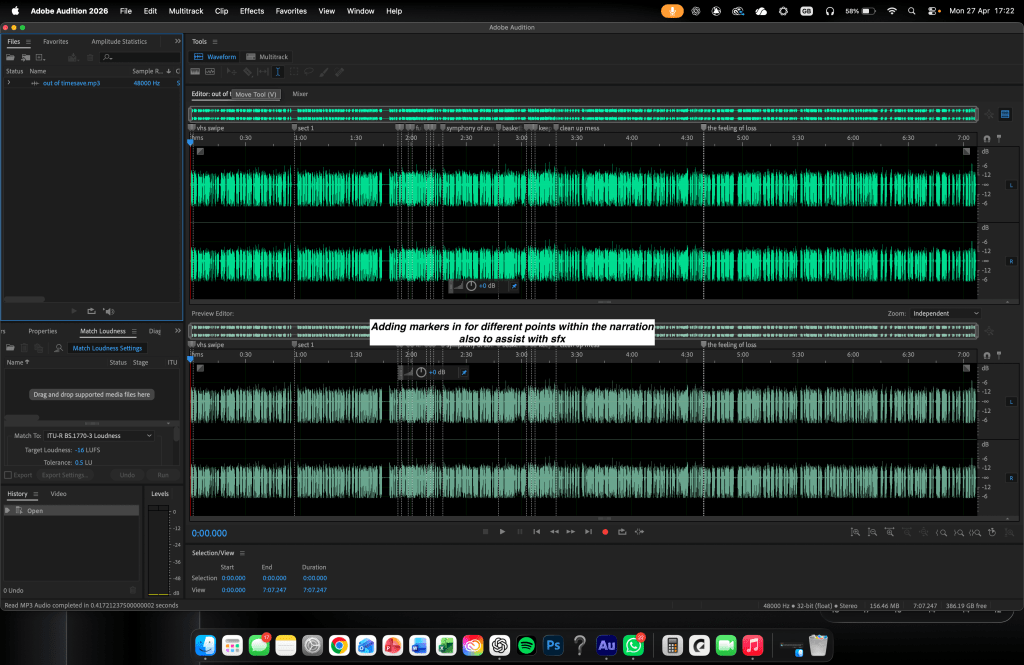
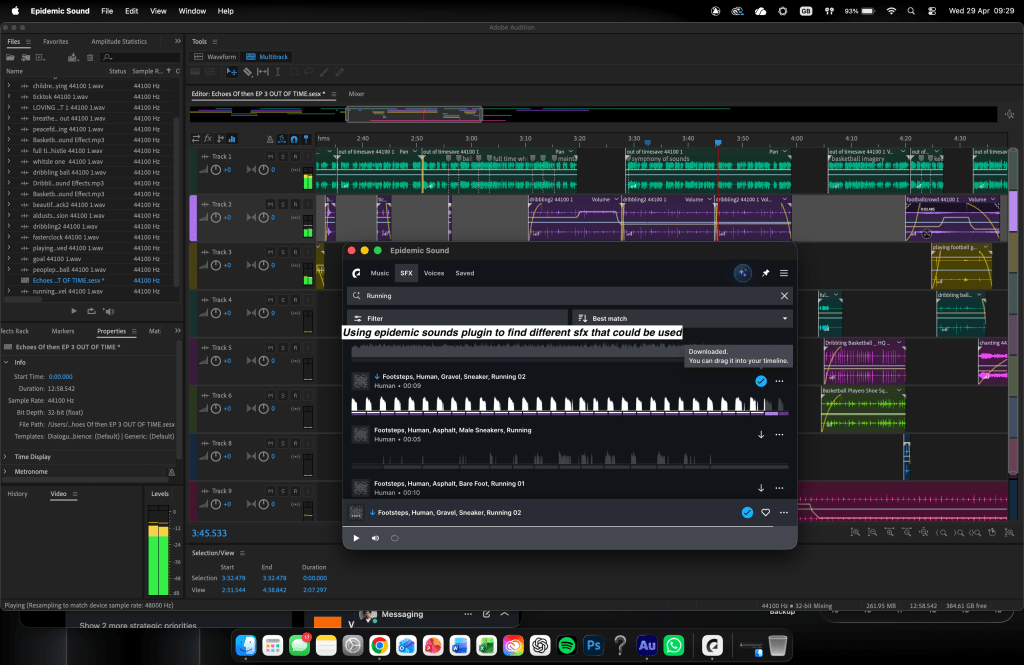
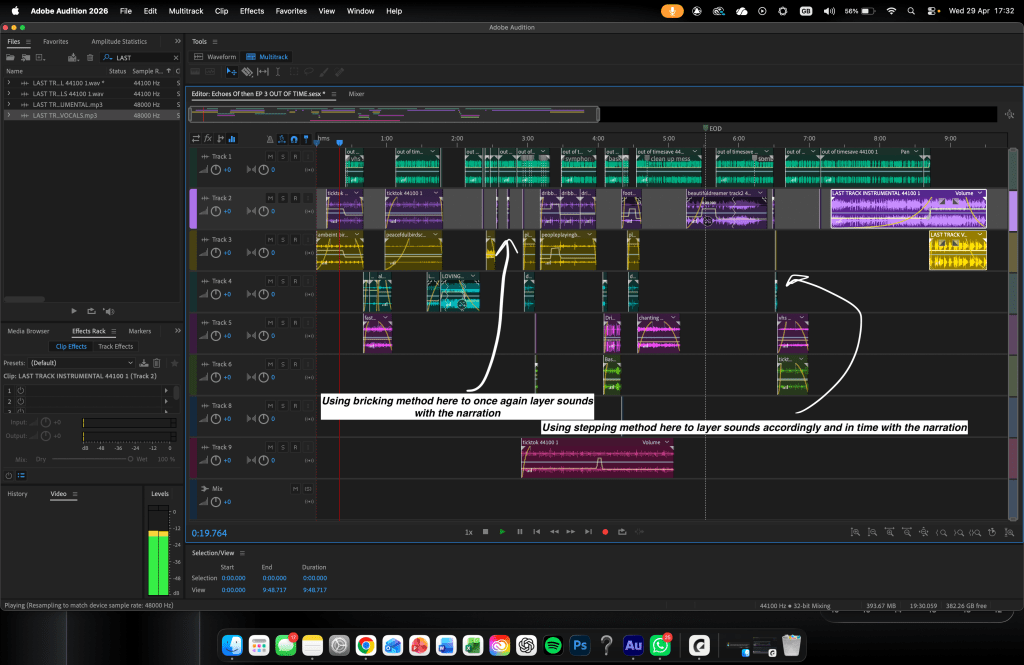
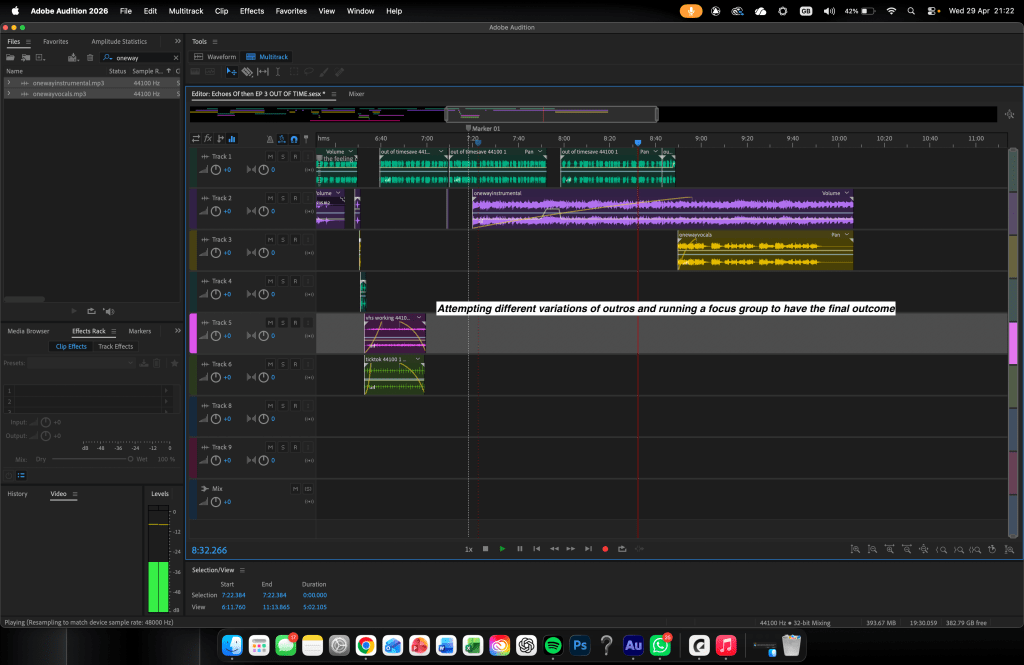
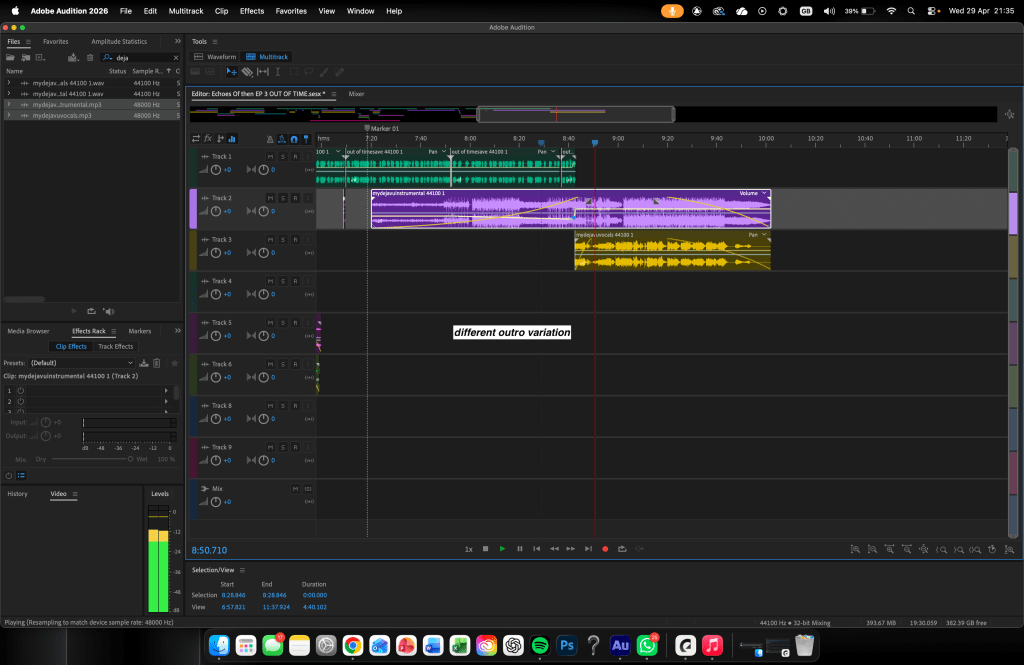
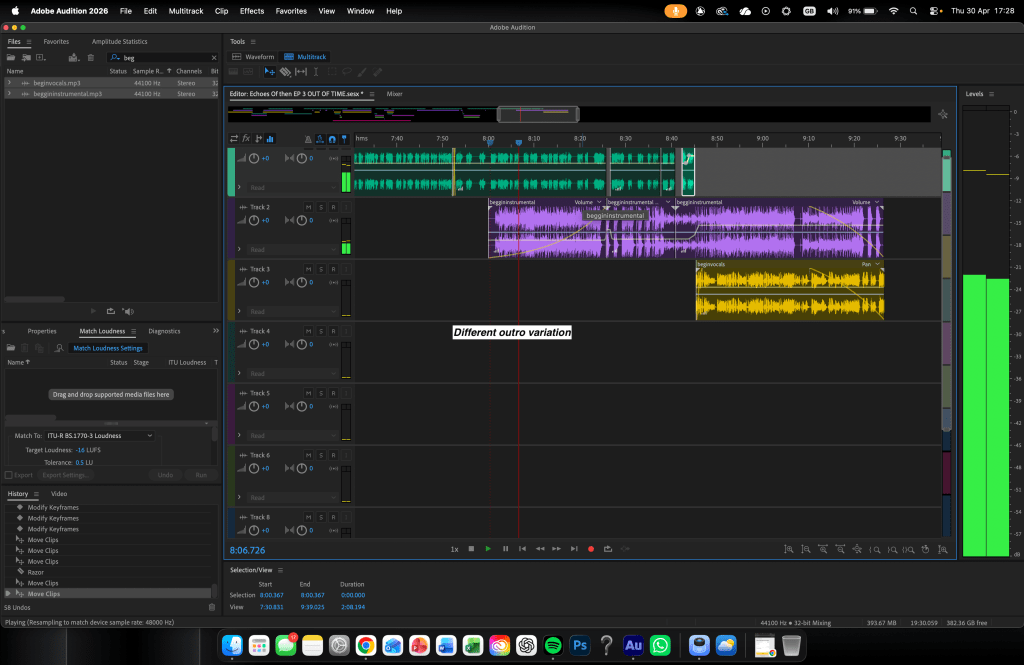
I also used a variety of different SFX to have a consistent sound design idea through the episodes. Below is a list of all of the SFX I used followed up by any of the music beds I may have used.
While I was going through the editing process as well my recording did come off too loud so I reduced the volume all the way down to -6 DB and also using the match loudness setting after the final mix down, a before and after screenshot is shown and this was done for all of the SFX I used to maintain consistency.
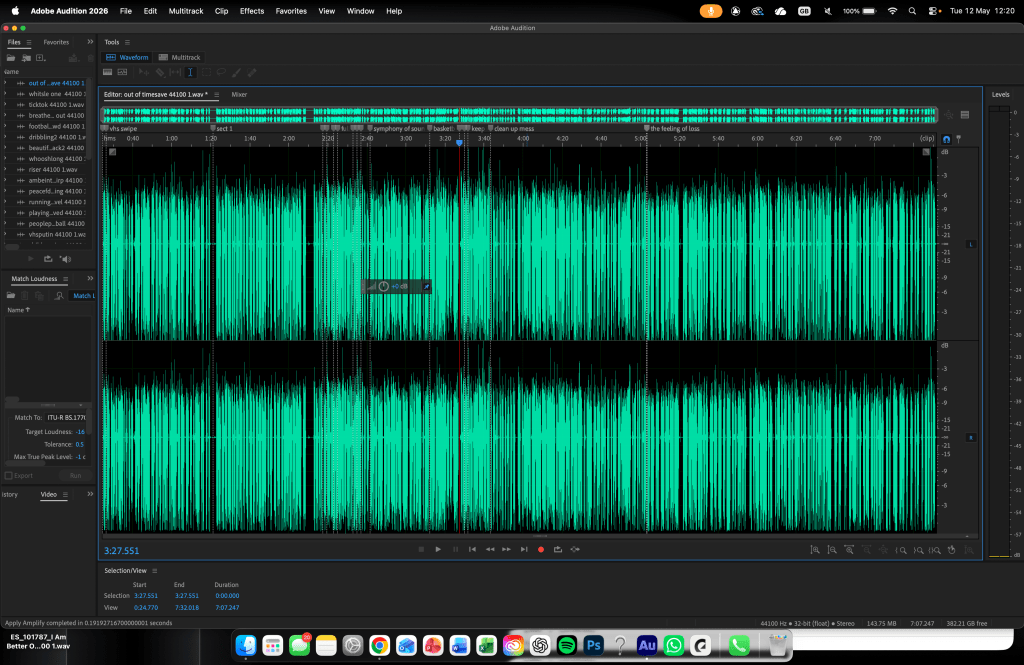
- Adult party discussion ambience SFX
- Birds chirping SFX
- Breathe in Breathe out SFX
- Chanting SFX
- Children Playing SFX
- Dribbling Ball SFX
- Dribbling ball 2 SFX
- Fast Swish SFX
- Faster Clock SFX
- Football Crowd SFX
- Full time Whistle SFX
- Goal SFX
- Kicking ball SFX
- Birds Chirping 2 SFX
- People playing ball SFX
- Goalkeeper Saving SFX
- Riser SFX
- Running on gravel SFX
- Ticking Clock SFX
- Whistle one SFX
ALL OF THE SOUND TRACKS ARE NOW AVAILBLE TO PLAY BELOW IN THE SAME ORDER AS ABOVE.
I also used a different variation of music beds too which are listed below.
- Loving you is the vibe MUSIC BED
- Beautiful Dreamer TRACK 2 MUSIC BED
- Fights Music BED
ALL OF THE SOUND TRACKS ARE NOW AVAILBLE TO PLAY BELOW IN THE SAME ORDER AS ABOVE.
Below is all of the platformed audio which has been attached too spotify and apple podcasts
The Playbook Stand Alone Episode – Broken Bodies
To continue with the sports theme and added with the theme of nostalgia I wanted to go back to the theme of memory, seprate from the Echoes of then documentary series I created a stand alone brand new episode for the playbook looking at 2 players from different sports and how injures can end careers and why players come back after a devastating one.
Below is the full script.
The Playbook – Broken Bodies – Full Script
Intro
Every athlete is taught the same thing.
Push harder.
Train longer.
Play through pain.
Because the body…
is the tool.
The engine.
The difference between making it
and being forgotten.
VOICE:
But what happens…
when that body breaks?
VOICE:
For some, it’s a moment.
A single step.
A single twist.
And everything changes.
Careers paused.
Seasons lost.
Futures rewritten.
Players like Jack Wilshere…
once seen as the future of English football—
held back by a body that wouldn’t cooperate.
Or Derrick Rose…
a generational talent…
forced to rebuild after injuries took away what made him special.
VOICE:
Some come back.
Some don’t.
And some…
are never the same again.
(pause)
Because in sport…
it’s not just the body that breaks.
It’s identity.
Confidence.
The version of yourself…
you spent your whole life becoming.
This is The Playbook.
A series uncovering the untold stories in sport…
The ones that don’t make the headlines—
but change everything.
and this is…
Broken Bodies.
VOICE:
Two careers.
Different sports.
Same reality.
In 2011…
Derrick Rose was at the top of the game.
The youngest MVP in NBA history.
Explosive.
Dynamic.
Unstoppable.
A player built on speed…
instinct…
and movement.
Until…
one moment…
changed everything.
A torn ACL.
And with it…
uncertainty.
For Rose…
recovery wasn’t just physical.
It was about rebuilding a game…
that depended on what he had lost.
He returned.
Again…
and again.
But never quite the same.
VOICE:
And maybe that’s the hardest part.
Not that you can’t play…
but that you remember exactly…
who you used to be.
In England…
Jack Wilshere represented the future.
A technically gifted midfielder—
fearless, composed, beyond his years.
At just 19…
he was competing with the very best.
VOICE:
But his story didn’t break in a single moment.
It wore down…
slowly.
Injury after injury.
Setback after setback.
Progress interrupted.
VOICE:
Not enough to end it instantly…
but enough to stop it ever becoming
what it could have been.
And that’s a different kind of loss.
Not the end…
but the almost.
Because sometimes…
the body doesn’t break all at once.
It just…
slowly takes things away.
OUTRO
Two players.
Two paths.
Same reality.
The body…
doesn’t always keep up with the dream.
In sport…
we celebrate what people become.
But we rarely talk about…
what they lose along the way.
Because some careers end in a moment…
and some are taken apart… piece by piece.
This was Broken Bodies.
From The Playbook.
The Playbook – Broken Bodies – Practical Skills
During the making of this episode I made sure of a number of things. Such as making sure that all of my sound fx were at -6 DB to make sure the mix down was clean. As shown in the screenshots below.
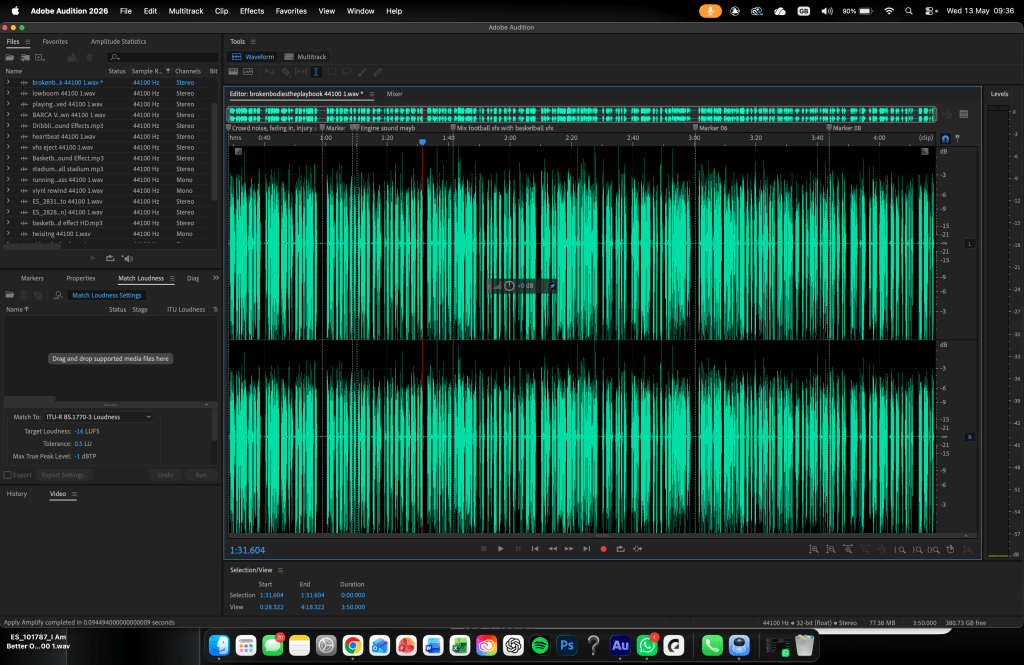
I also used Epidemic Sounds for this episode to get audio that was copyright and royalty free to not get blocked by different streaming platforms online as I did so previously. Furthermore, I matched the loudness to -16 LUFS to make sure the broadcasting standards were being met on the streaming platforms
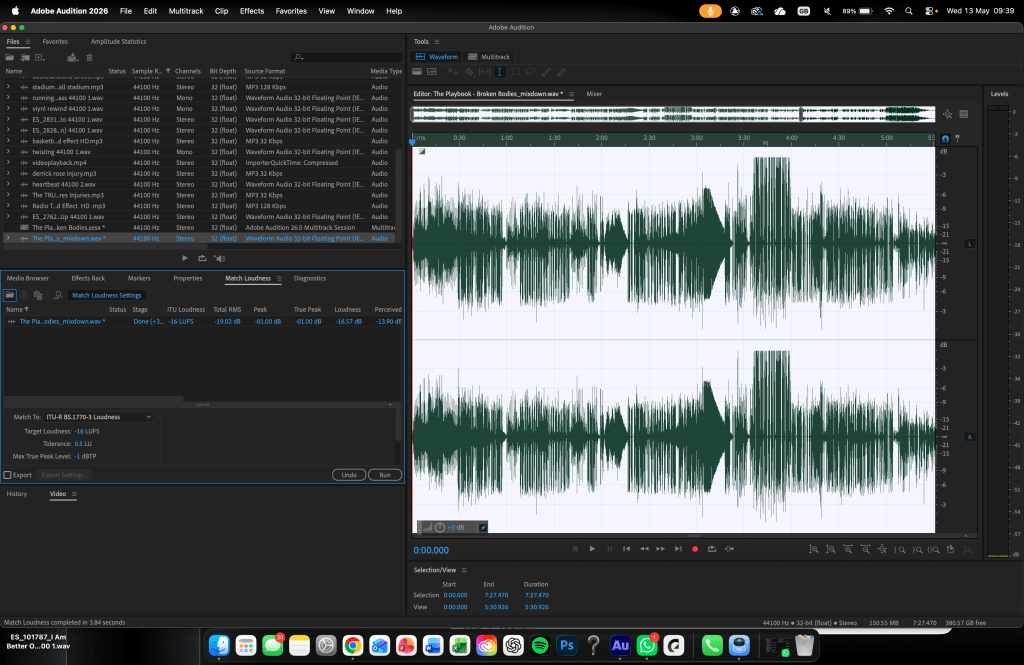
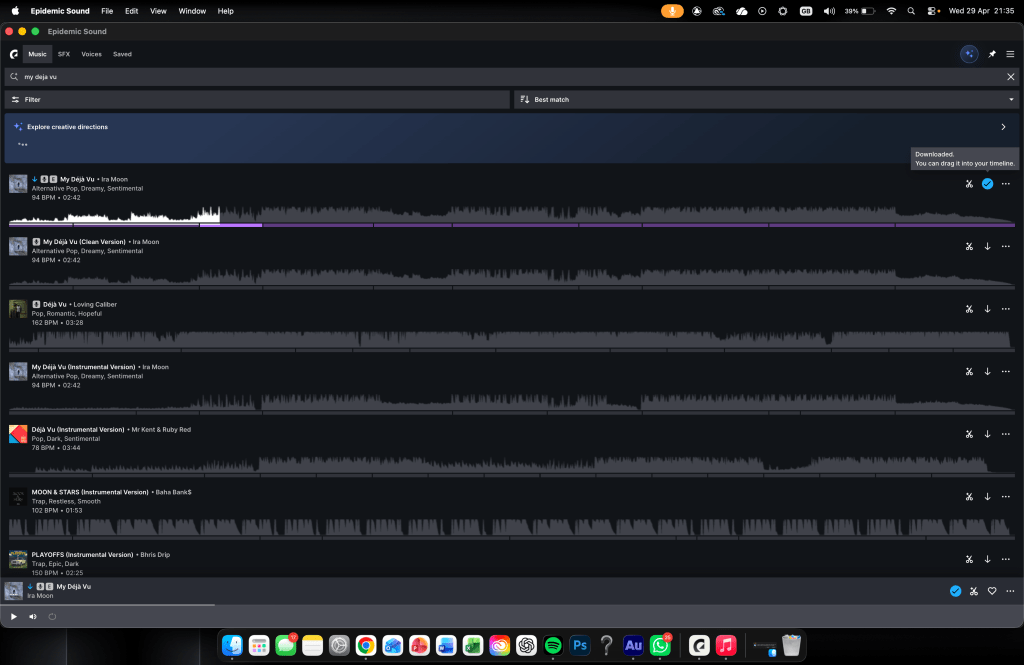
Throughout the project I did not use a wide variety of sound fx as I did in the, Echoes of then, series rather I focused more on adding music beds, as stated previously all of these are listed below and from epidemic sounds.
SFX
- Metal hitting floor
- Glass Breaking
- Metal Sounds
- Running on grass
- Twisting
ALL OF THE SOUND TRACKS ARE NOW AVAILBLE TO PLAY BELOW IN THE SAME ORDER AS ABOVE.
Music Beds
- Level Up
- Conjunto
- What Child is this (INSTRUMENTAL)
ALL OF THE SOUND TRACKS ARE NOW AVAILBLE TO PLAY BELOW IN THE SAME ORDER AS ABOVE.
Audio Clips
- Derick Rose talking on injury
- Jack Wilshire talking on injury
Final Products
Echoes of then EP1
Echoes of then EP2
Echoes of then EP3
Stand Alone Episode, The Playbook, Broken Bodies.
 Imad Daili - Sports Media