For this week we began and finished the Chris Powel radio interview alongside the Joe Cole and Owen Hargreaves interveiew, the goal was to cut it down from 20 mins all the way down to 3 distinct sections to be included within the radio links, the target audience for this was around 15-35 years old who are intrested in general sports and insights into sports players and what they do etc.
Research
Technical
We researched multiple different editing daws to edit the peice of audio such as, audacity and adobe audition. And I ended up using adobe audition because of its user friendly enviorment in comparision to audacity alongside that we had already been familliar with it from last year.
Story
The way I interpreted this brief was to research different features and editing techniques that I could use in my own editing forms. Such as ensuring to cut and delete long pauses and filler words in the vocals, ensuring a high quality fast pace turn out good for broadcast. We researched different sports based radio stations such as talk sport and bbc 5 live and saw how they did theirn interviews and how we could adapt it to ours.
Stylistic
Our inspiration for this was largley taken from different talk sport interviews due to how they edit them, with their quick cuts maintaining their fast paced format all the way through the interview.
Problem Solving
Problem: Cutting a 20-minute interview down without losing key information. Solution: I selected the strongest and most relevant answers.
Problem: Filler words and long pauses slowed the interview down. Solution: I removed them carefully in Adobe Audition.
Problem: Some sections lacked pace for radio. Solution: I used quicker cuts inspired by talkSPORT and BBC 5 Live.
Evaluation and Reflection
What Went Well (WWW)
I successfully cut the interviews down while keeping the strongest content.
The final edits had a quicker, more professional radio-style pace.
I used Adobe Audition confidently to clean and structure the audio.
Even Better If (EBI)
I could plan my chosen sections earlier to speed up the editing process.
I could improve the consistency of audio levels between speakers.
I could use more advanced transitions and processing to make the edits even smoother.
On this week of my FMP, my main focus was completing the standalone sports focused episode of my running series, The Playbook. Titling it “Broken Bodies.” This was also while beginning and completing the practical skills section of my FMP. Although Broken Bodies was not directly apart of, Echoes of Then, it directly supported the wider development of my audio documentary and sound design skills.
Researc
Story
The narritave focus of broken bodies was centred around athletes struggling with injury, pressure and failed comebacks. My main inspiration for this was after hearing about Jack Wilshire, someone who was regarded as the future of english football. But he was prone to injury but he still kept trying to come back to the sport. But it was never the same.
The video I saw is linked below.
The episode was designed to feel more emotional and cinematic than factual. Focussing heavily on story telling and atmosphere rather than statistics or traditional sports reporting.
This was useful for my FMP overall because it allowed me to continue developing documentary narration techniques and emotional pacing outside the scope of Echoes of then,.
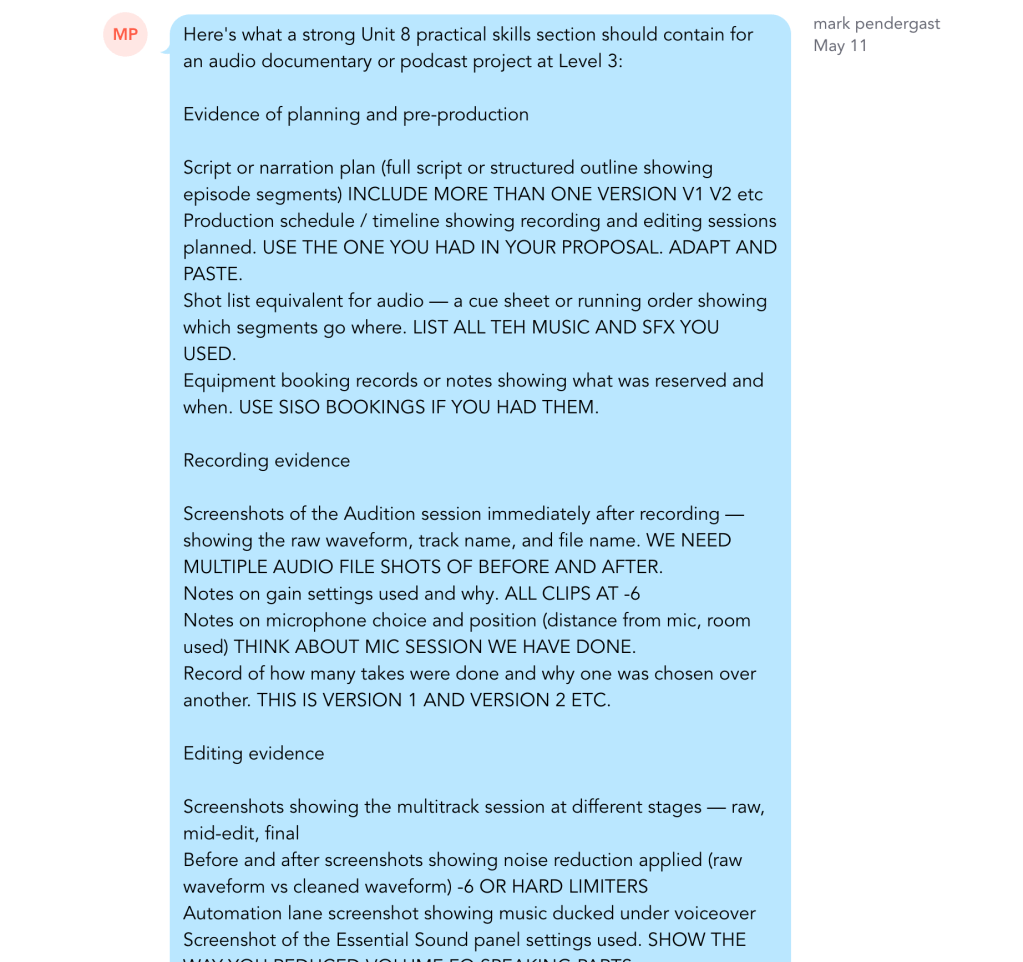
Alongside this, the practical skills section of my website became a major focus this week. I researched what evidence is required for a Level 3 FMP practical skills page and developed the page further. more professional pridcution evidence and clearer technical explanations.
We were provided with a template on things that we should include for a good turn out and that has been attached below.
Stylistic
Broken bodies continued to build on the documentary tone, developing throughout echoes of then. The episode used slower pacing, cinematic music and layered ambient sound design to create emotional weight around athletes being discussed.
I focused heavily on allowing narration and atmosphere to work together rather than constantly filling yhe documentary with sound. Silence, slower transitions and structured rather than simply becoming a large collection of screenshots. S
Technical
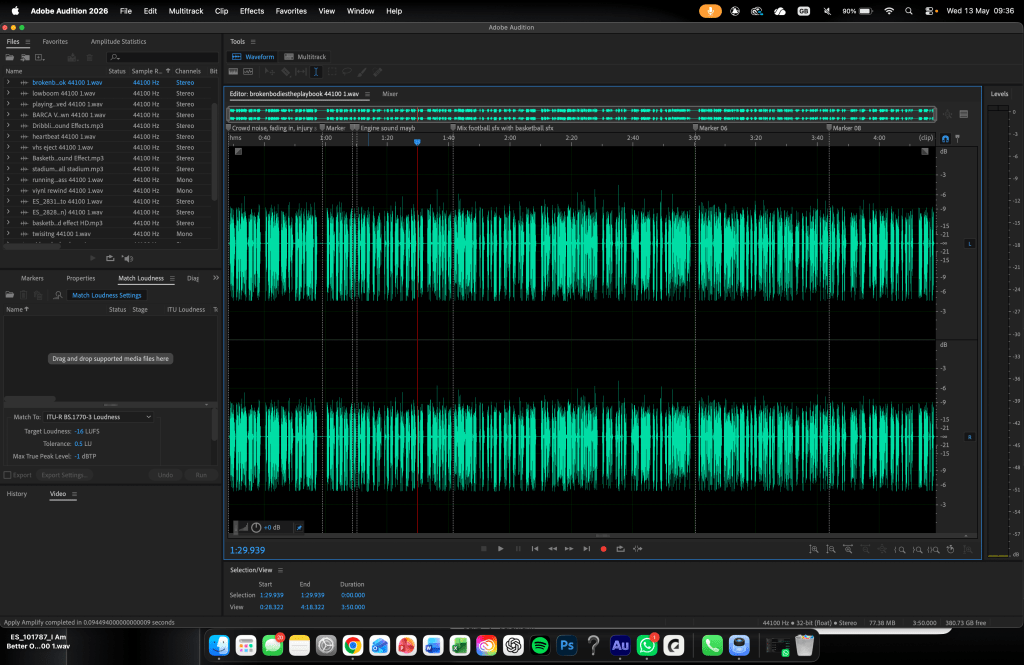
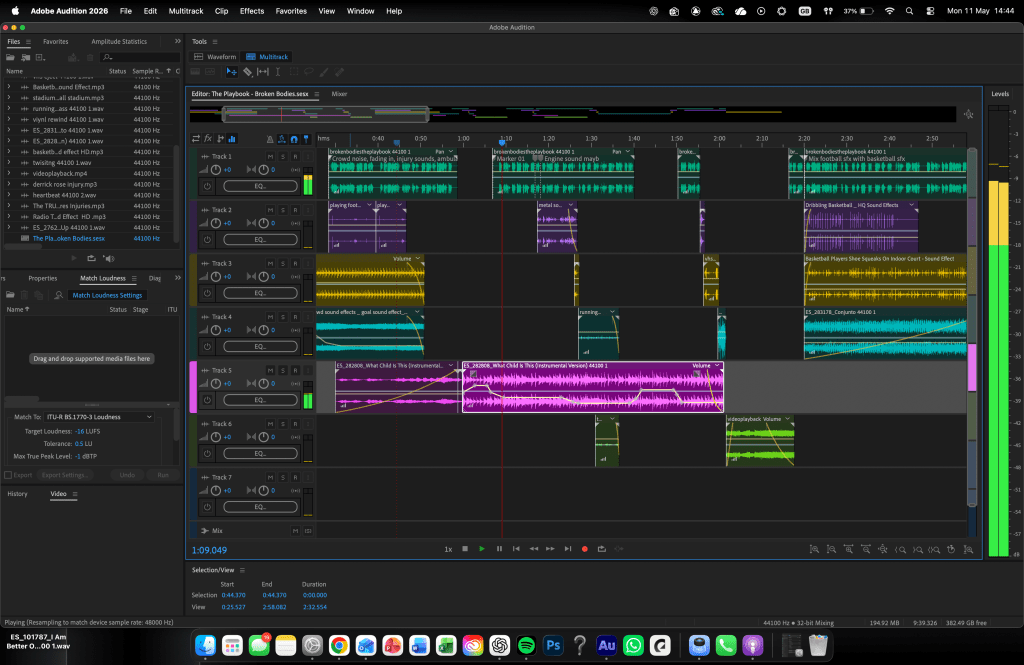
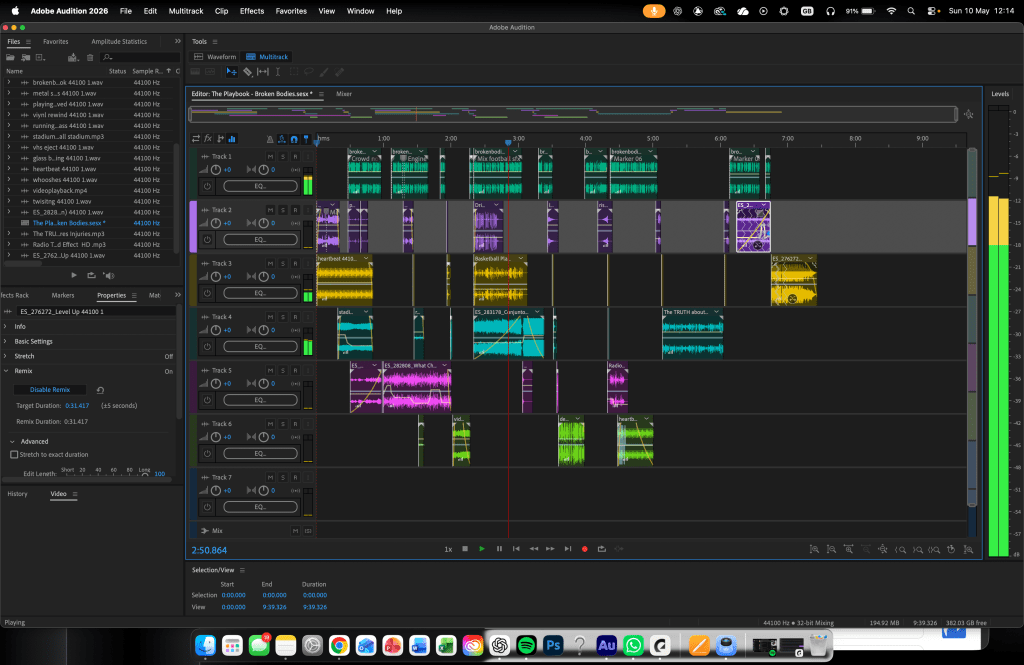
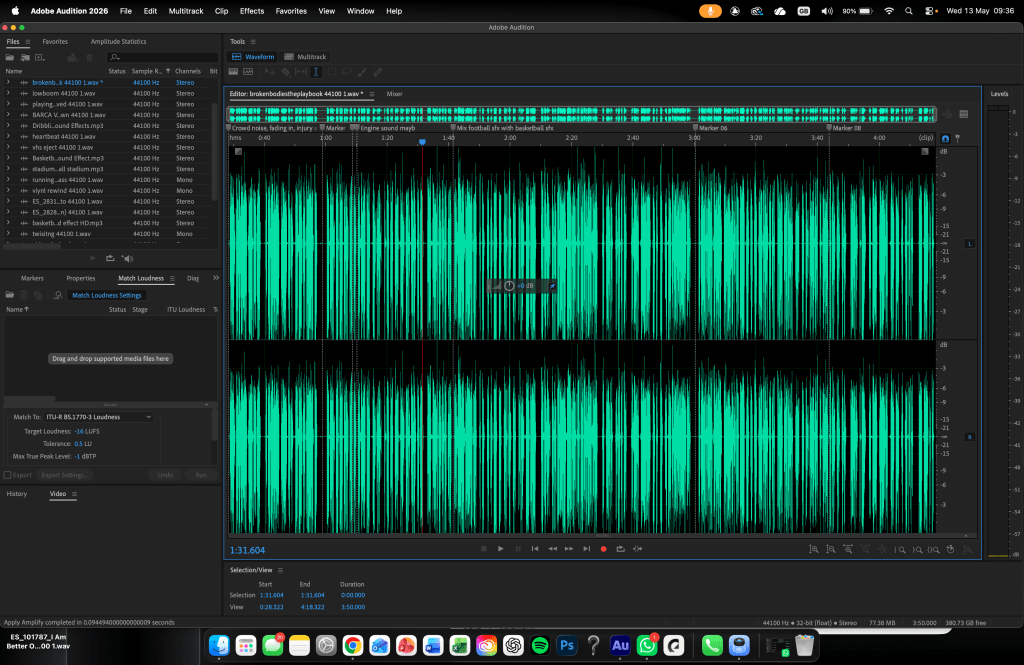
Technically, this week was heavily focused on editing and documenting workflows professionally. Broken Bodies was edited in Adobe Audition using multitrack sessions with layered narration, cinematic music beds and atmospheric sound design.
I continued using my vocal processing chain including:
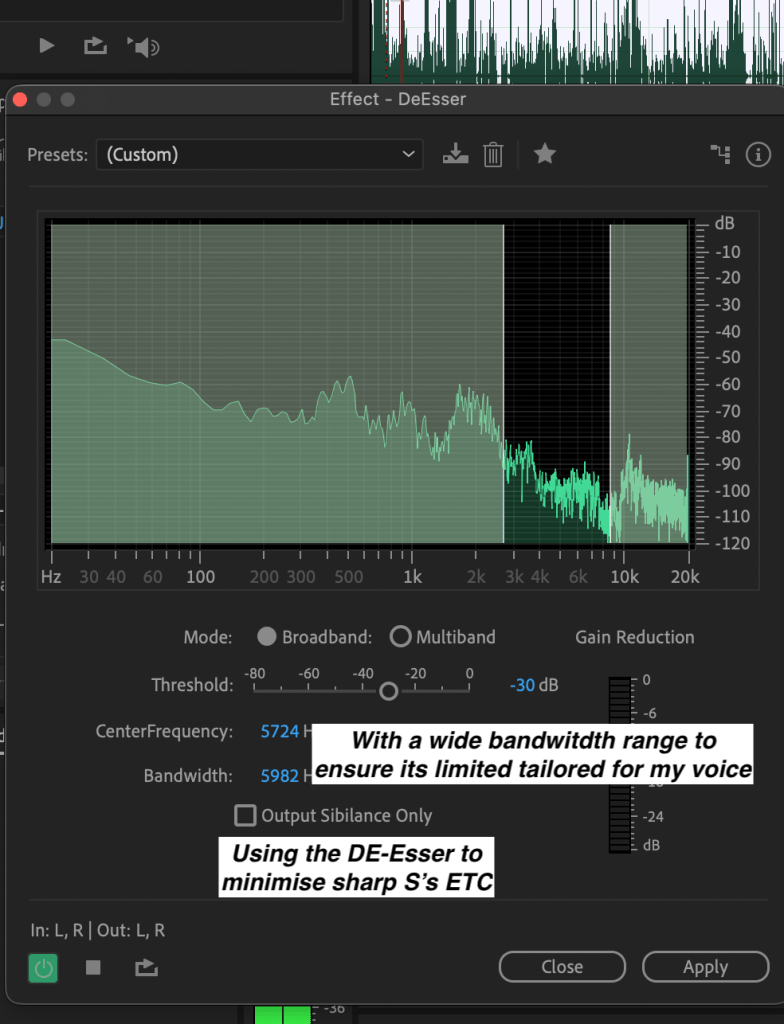
De-Esser
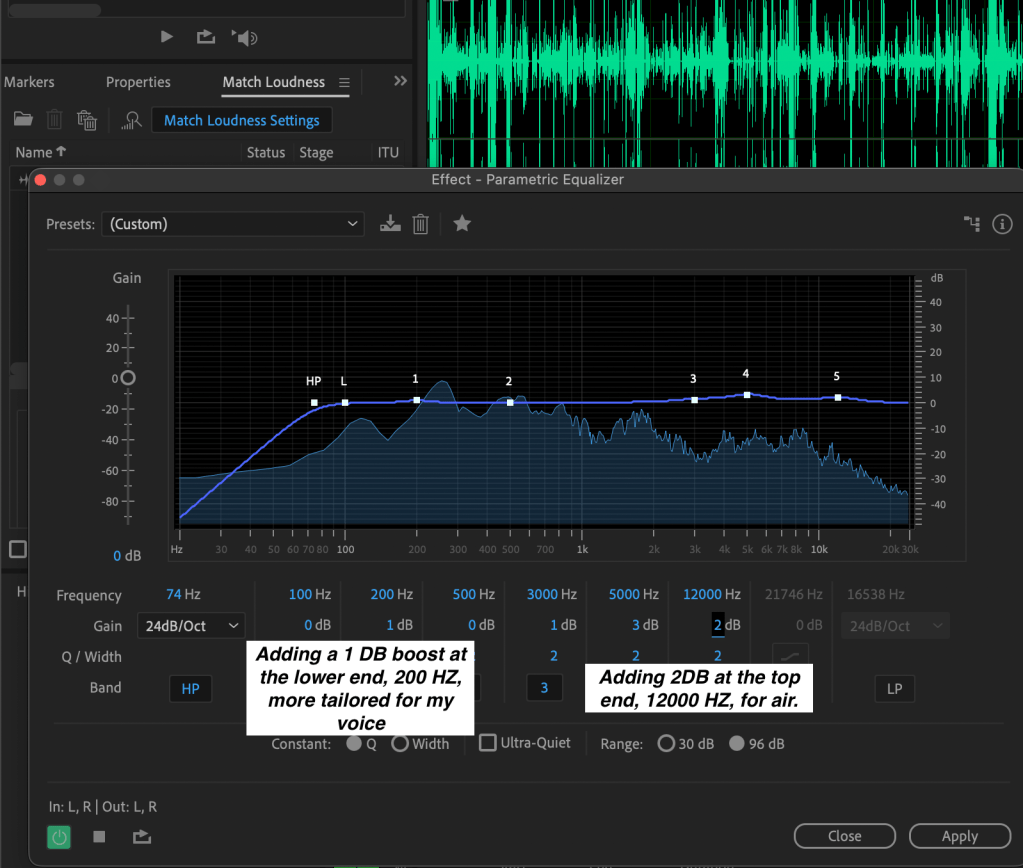
Parametric EQ
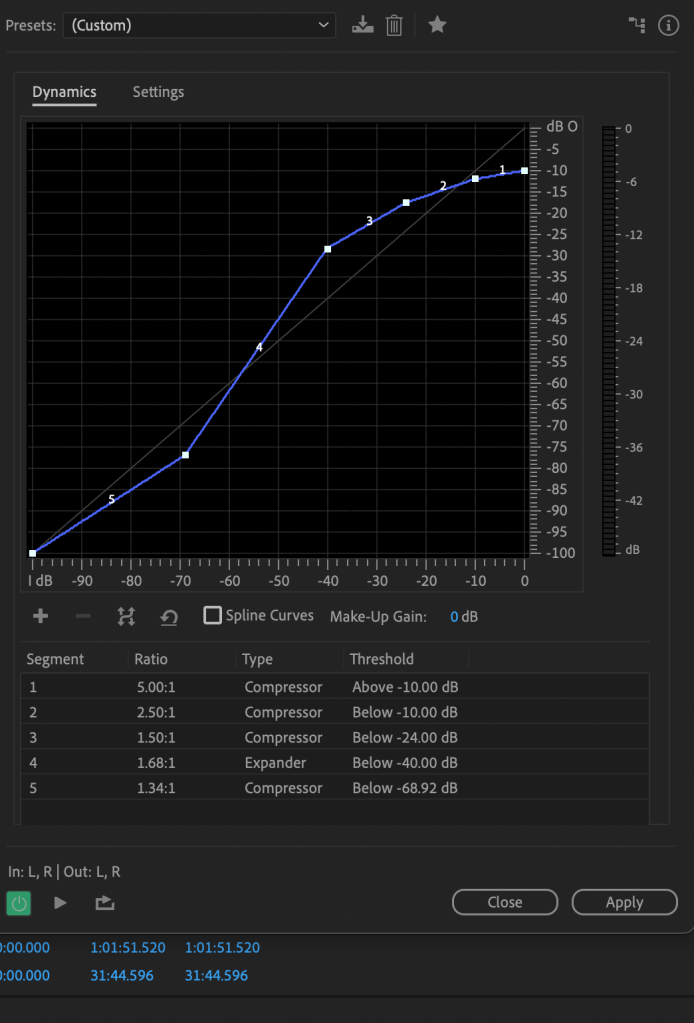
Dynamics Processing
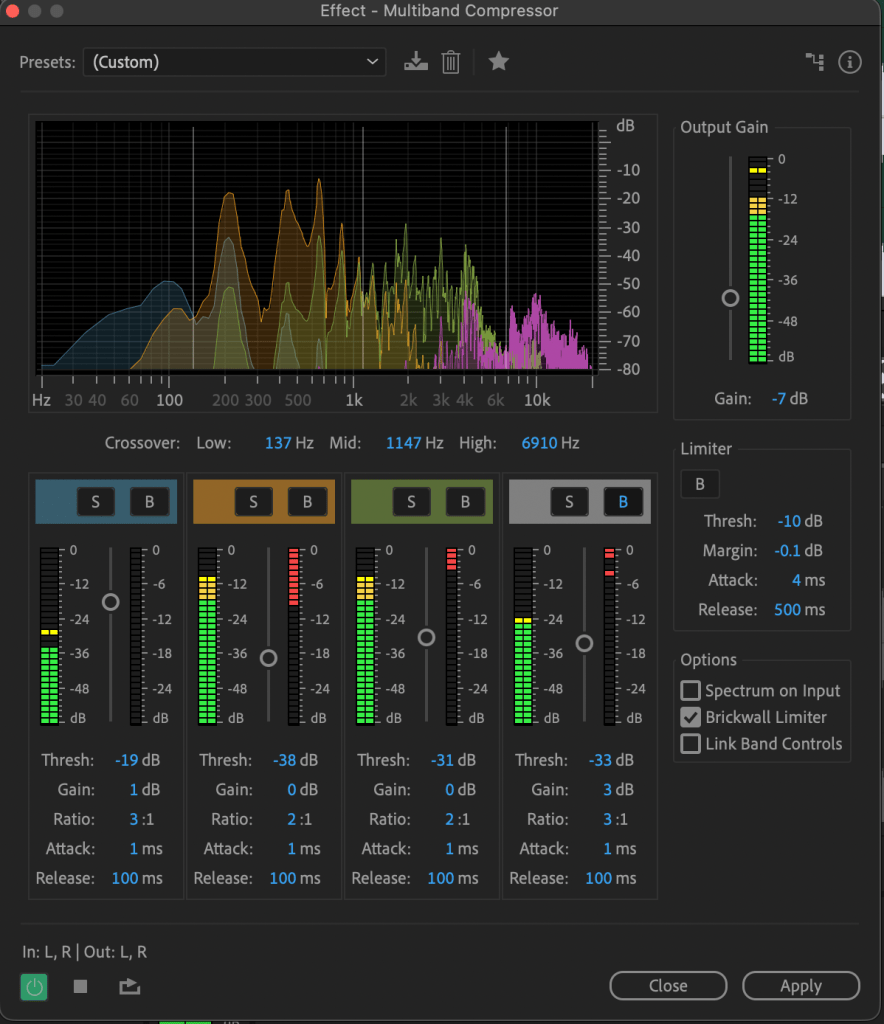
Multiband Compression
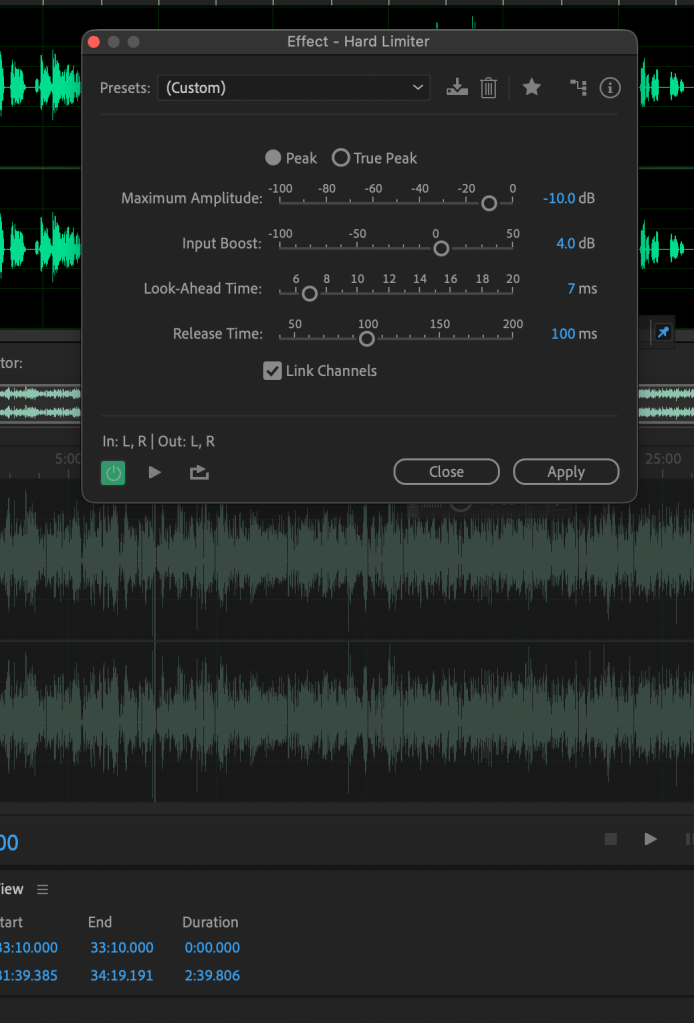
Hard Limiter
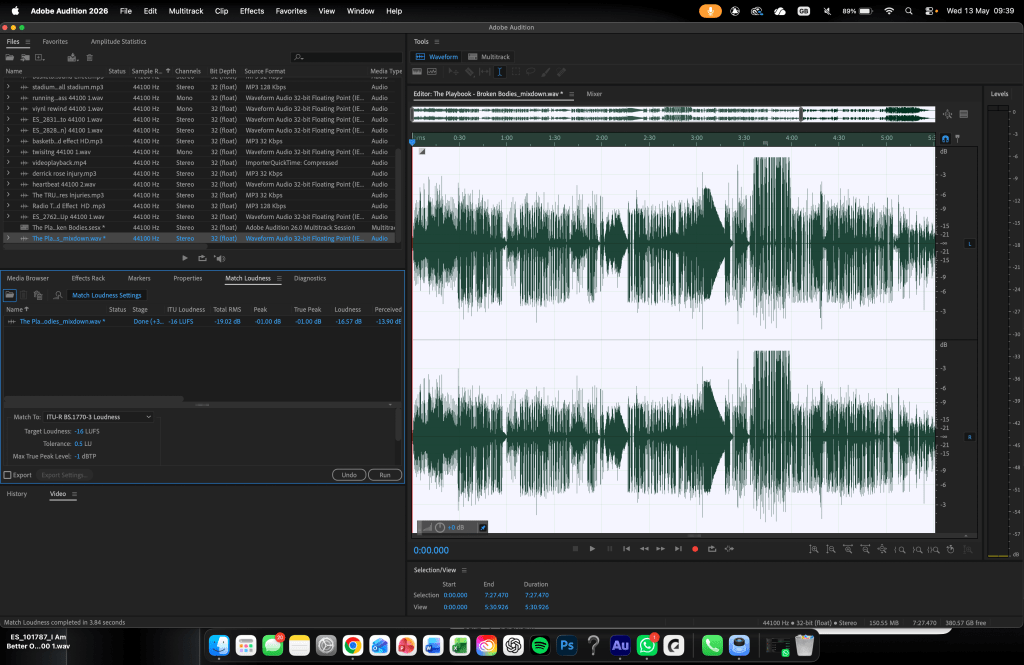
Screenshots are shwon below
Practical Skills
The practical skills this week were heavily focused on organisation, documentation and professional presentation. I completed the practical skills section of my website by structuring all evidence into clear production stages including pre-production, recording, editing, sound design, processing and exporting.
I added:
script drafts
cue sheets
production schedules
raw and processed waveform screenshots
vocal chain screenshots
automation evidence
LUFS/export screenshots
equipment comparisons
sound design explanations
This allowed the website to feel much more like a professional production portfolio rather than just a collection of edits and screenshots.
Alongside this, I completed the full production workflow of Broken Bodies, from scripting and narration through to final editing and sound design.
Evaluation and reflection
What Went Well (WWW)
1. The practical skills section became much more professional and detailed. The final website now clearly documents all stages of the production process, including scripting, recording, editing, sound design and exporting. This makes the workflow easier to understand and properly evidences the technical skills used throughout the project.
2. The pacing and atmosphere within Broken Bodies were effective. The slower narration, cinematic sound design and quieter reflective moments helped create emotional weight and made the documentary feel more mature stylistically.
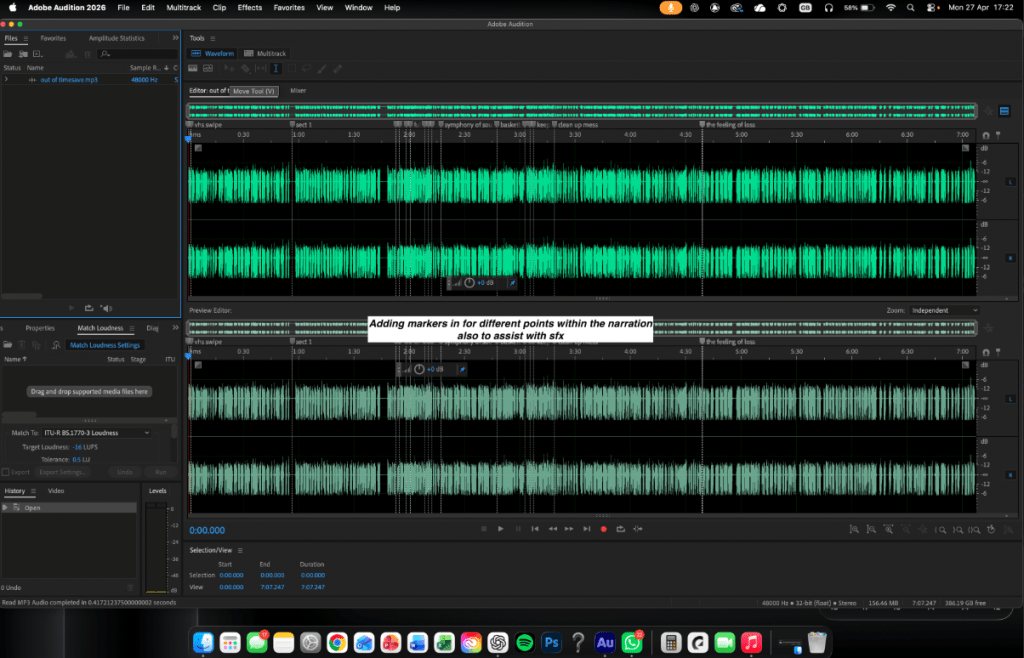
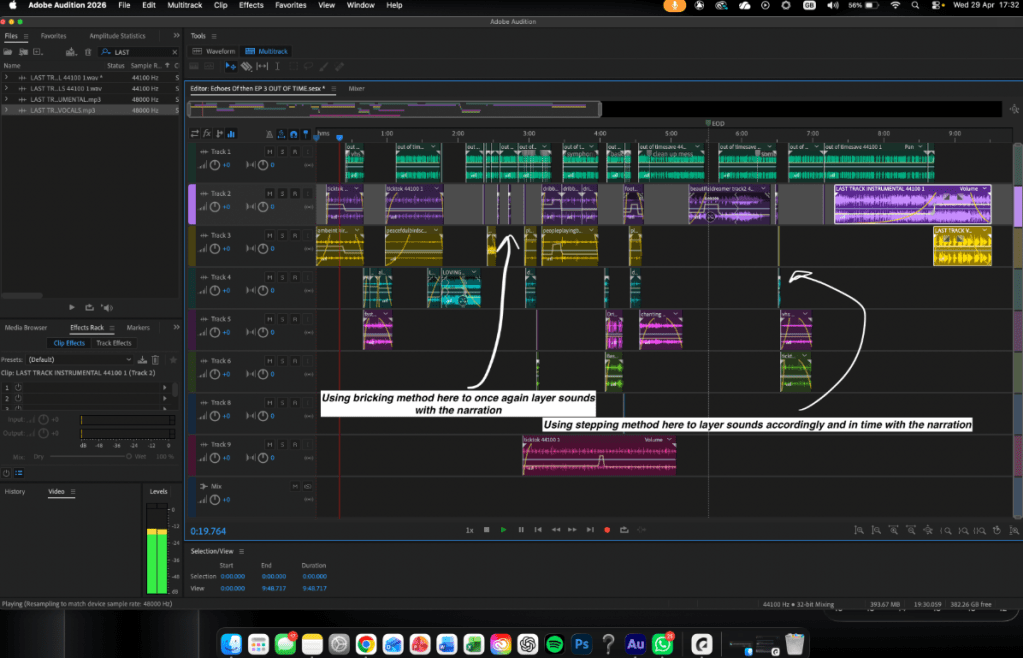
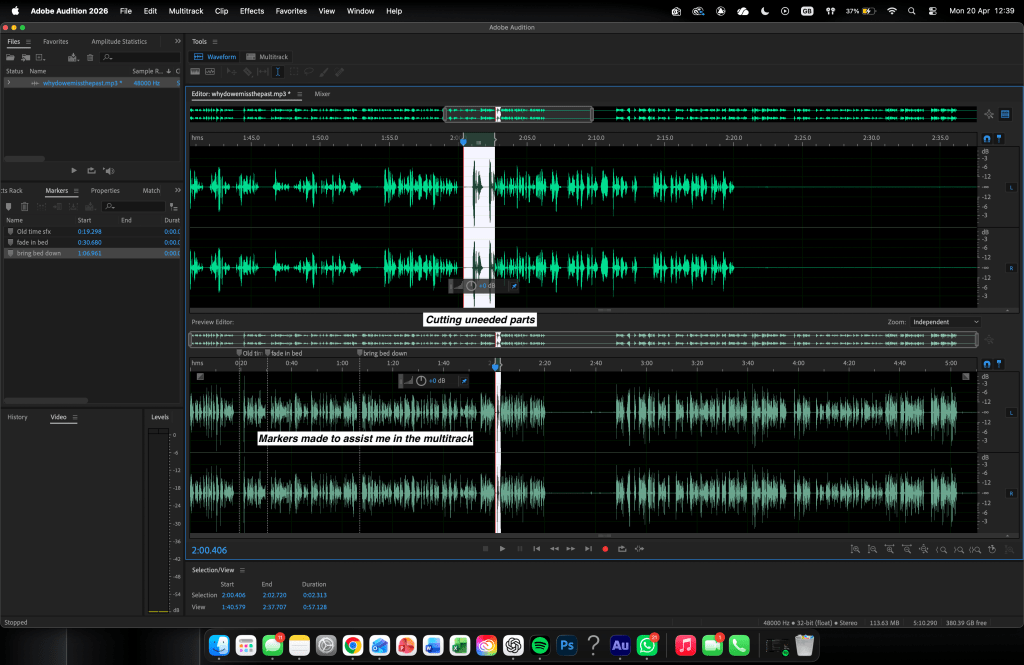
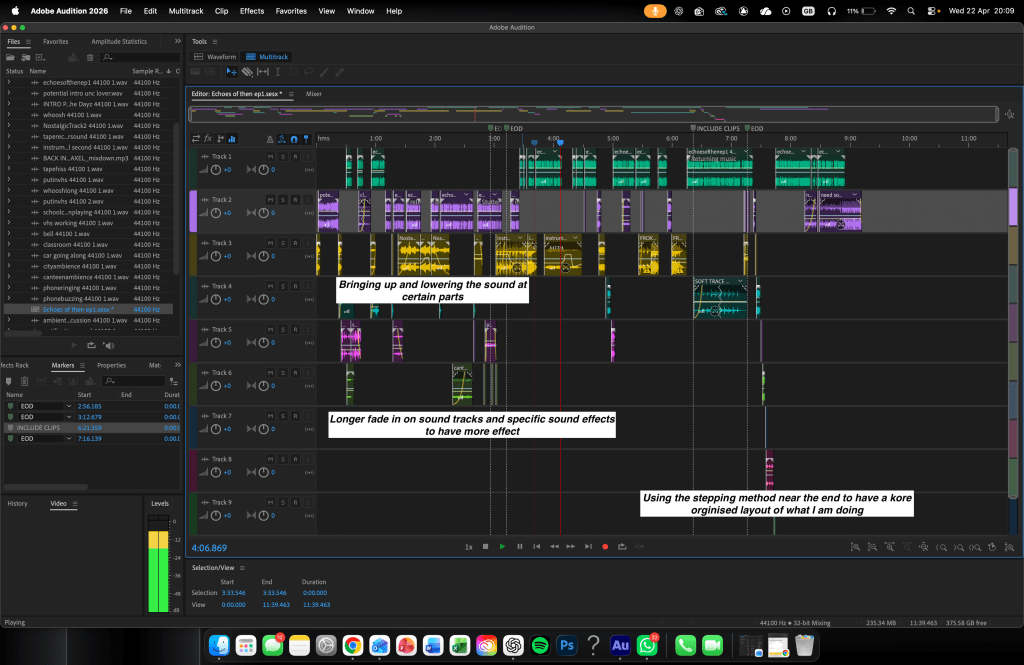
3. My technical workflow became more organised overall. Using clearer session organisation, markers, bricking and stepping techniques improved efficiency while editing and made larger multitrack sessions easier to manage.
Even Better If (EBI)
1. Some sections of the practical skills page could still be simplified visually. Although the page now contains strong evidence, there are some sections where the amount of screenshots and text becomes visually dense. Breaking some sections up further could improve readability.
2. More original sound creation could improve the documentary further. While the sound design was effective overall, recording more custom Foley sounds or atmospheres would help make the documentary feel even more unique and cinematic.
3. The scripting process could be refined earlier. Some sections of narration were adjusted repeatedly during editing, which increased production time. More detailed scripting drafts earlier in production would make the workflow more efficient overall.
For this week on my FMP, my main focus was completing the third episode of my project, titling it “out of time.” The episode was again targeted towards an audience of 16-23 year olds with a secondary audience of 26-33 year olds. The episode was designed to act as the conclusion to the three part documentary, bringing together the emotional themes of episode one and the more analytical themes of episode into a final reflective piece.
The aim was to provide clarity around the idea of nostalgia, explaining war the feeling actually is and why memories often feel more meaningful after a time has passed. I also needed to subtly integrate a sporting influence into the episode without changing the core theme of the project
Research
Story
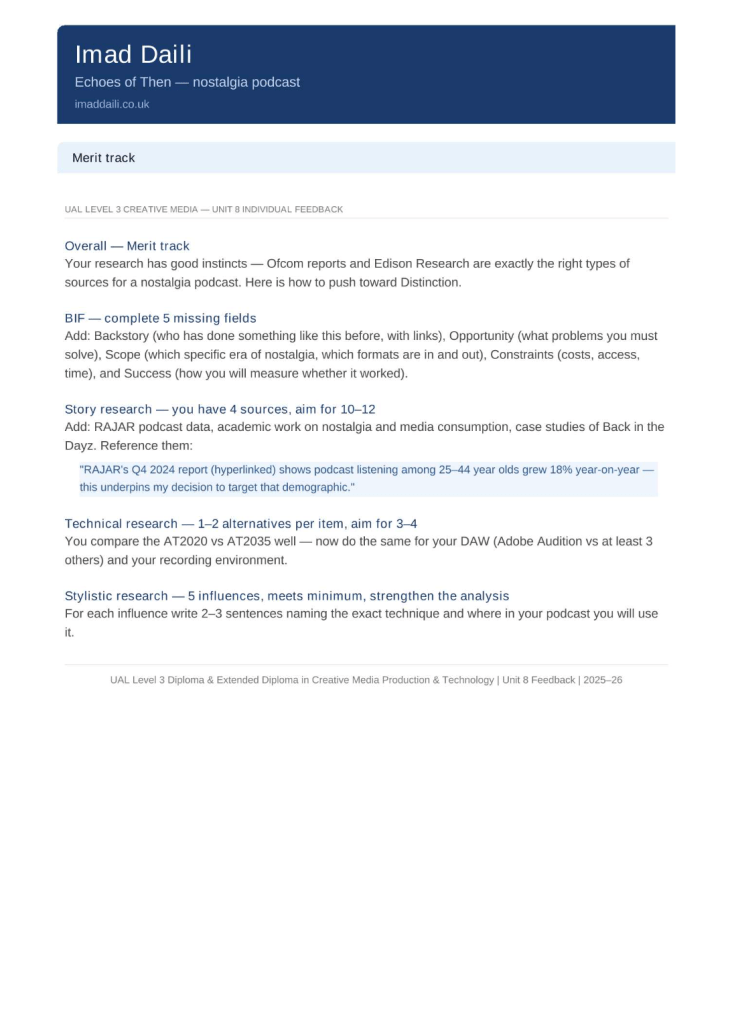
The main focus this week was developing the script structure for the final episode making sure it acted as a real conclusion to the series. Another focus was after recieiving feedback on my research section of my amp and had to adapt the context section and the main research section tpp.
I also developed real life examples throughout the script to make the concepts feel more relatable and grounded. Using football, basketball and live match experiences allowed the spiked to subtly connect back to sport while still remaining focused on nostalgia and memory.
Stylistic
Stylistically I was more inclined to take the ideas from other audio documentary titled, “The story of the Nike in football, which is linked below. This was to further evoke that sporting imagery within the episode and how much of anything especially sports can be nostalgic.
I needed episode 3 to feel calm and grounded, this is in comparison to the darker tones of episode 2 and the warm and reflective idea of episode one. The sound design in the episode relied on creating a very calm environment with some birds chirping but also relating the episode to time hence the clock ticking at all times.
Technical
The technical focus was to refine my pace as said in the last weeks EBI, narration and atmosphere to create a polished outro to the series. The narration was recorded in a treated environment with an AT2020 and edited using Adobe audition on a MacBook Pro M2.
I further used my vocal chain within the edit to have refined vocals and maintain consistency throughout the episodes. Such as:
Parametric EQ
Dynamics Processing
Multiband Compressor
Hard Limiter
De-Esser
Practical Skills
This week’s practical skills were based around scripting, recording and editing the final episode of the documentary series. A major focus was making sure the final episode felt like a conclusion rather than just another instalment.
I experimented more with pacing and silence, allowing certain sections to breathe rather than constantly layering sound effects underneath the narration. I also developed stronger scripting techniques by using real-life examples and metaphors to explain more complex ideas around nostalgia and perspective.
Evaluation and Reflection
What Went Well (WWW)
1. The final episode successfully concluded the series.
Episode 3 brought together the emotional and analytical themes explored throughout the project and provided a clear ending to the documentary series.
2. The sporting examples felt natural and subtle.
Using football, basketball and live match experiences helped connect the project slightly back to sport without distracting from the main topic of nostalgia and memory.
3. The pacing and atmosphere were more controlled and mature.
The slower pacing, softer sound design and use of silence helped the episode feel more reflective and polished compared to earlier episodes.
⸻
Even Better If (EBI)
1. Some sections of narration could still be shortened slightly.
Although the reflective pacing worked well, a few sections could be made more concise to improve overall flow and maintain engagement.
2. More experimentation with ambient sound could improve immersion further.
While the atmosphere worked effectively overall, adding a wider range of subtle ambient textures could help make certain moments feel even more immersive.
3. The editing workflow could be prepared earlier.
Preparing more sound assets and music choices before editing would help make the post-production process faster and more efficient in future projects.
On this week of my FMP, the main focus was recording and editing the second episode of my project titling it, “Repackaging the past”
This episode was a direct build from episode one, which setup the foundation as to what was the main subject of the documentary series. I wanted EP2 to look from more of an anlylitcal point of view being much more aggressive in its style, feeling like more of an accusation rather than a calm vibe EP1 was aiming for.
The aim was to challenege the listener’s perception, showing that nostalgia is not just a feeling but it can be some thing that is deliberatley constructed, edited and used. I ensuured for the episode that it remained accessible and engaging for the primariy audience of 16-24 year olds, while maintaining the depth for the secondary audience of 25-36.
Research
Story
I did not want to simply explain what nostalgia was, episode 2’s aim was to focus on how the past can be repackaged and presented back to audiences. The structure of the script was designed to guide the listener through the idea step by step, allowing them to take in the thoughts and ideas I was attempting to represent.
The episode still connects back to my core research into memory, media and nostalgia but applies it in a more critical and thought provoking way, helping to develop the overal direction.
This also entails within the script which can be found here. And the script was designed to be shorter and more hard hitting with more impactfull wors that allowed to sink into the audience.
This is all coupled with me experimenting with more of a narritive structure in comparison to episode one, introducing moments that directly distrupt the listener’s expectations.
Stylistic
Stylistically, this episode is in a direct contradiction to episode one while it still manages to remain as a step up and a build from the foundations that episode one layed out
The first episode focused on warmth and reflection, episode 2 introduces a more unstelling and controlled tone. I used sound design to manipulate the listenr’s ecxpectations, including moments where the audio creates a false sense of comfort before being interuptted.
An example of this is shown below
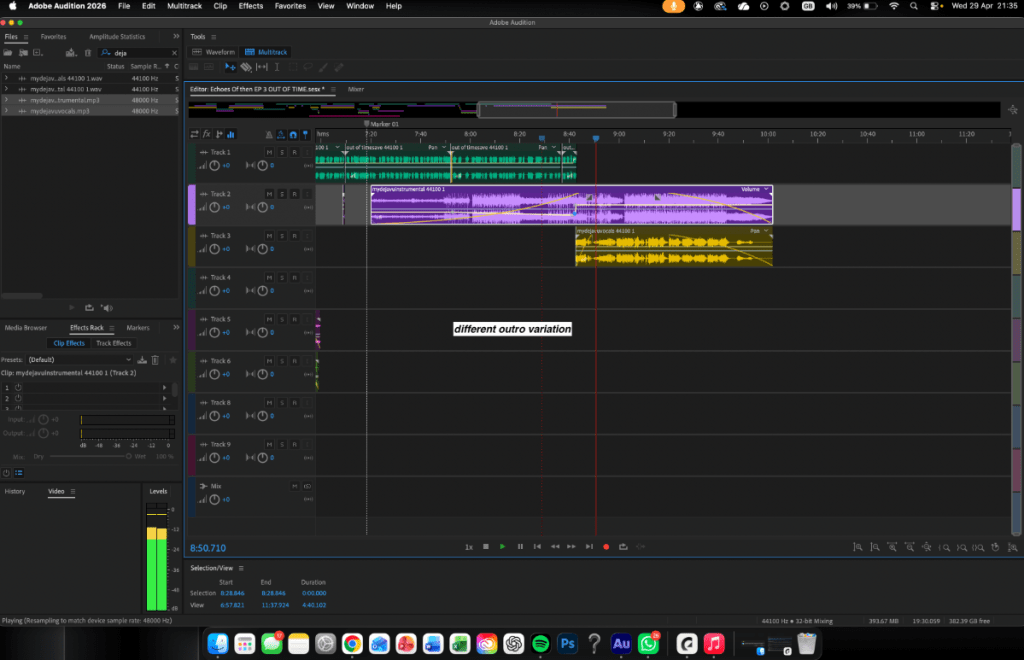
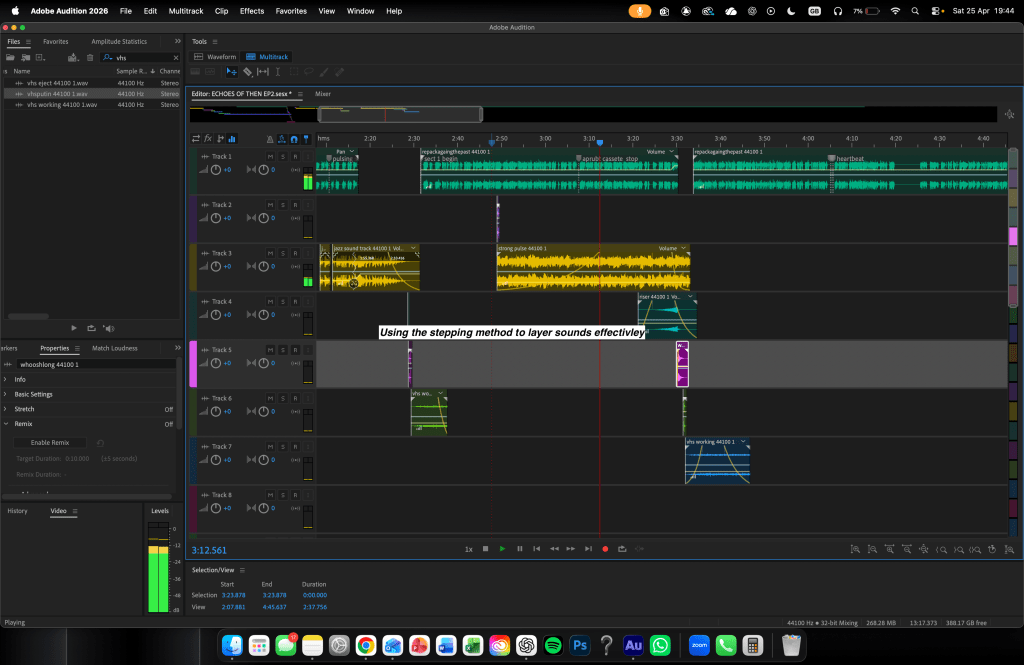
I introduced a jazz style track at the beginning to create a calm, familliar atmosphere before cutting it and replacing it with glitch effects, to act as iot something was wrong with the vhs tape that was put in, a rewind effect then comes in with the idea of “attempting to fix” the problem but now the truth was going to revealed in the broken tape.
As the episode progresses the tone becomes darker, with pulsing sounds and more unsettling audio designed to feel like an accusation as iof the listneer was being cornered. This then shifts into reputting a different VHS which does work “properly” at the end which fits for a familliar, nostalgic ending.
Technical
The technical focus was to aim for vocal clarity and complex sound layering
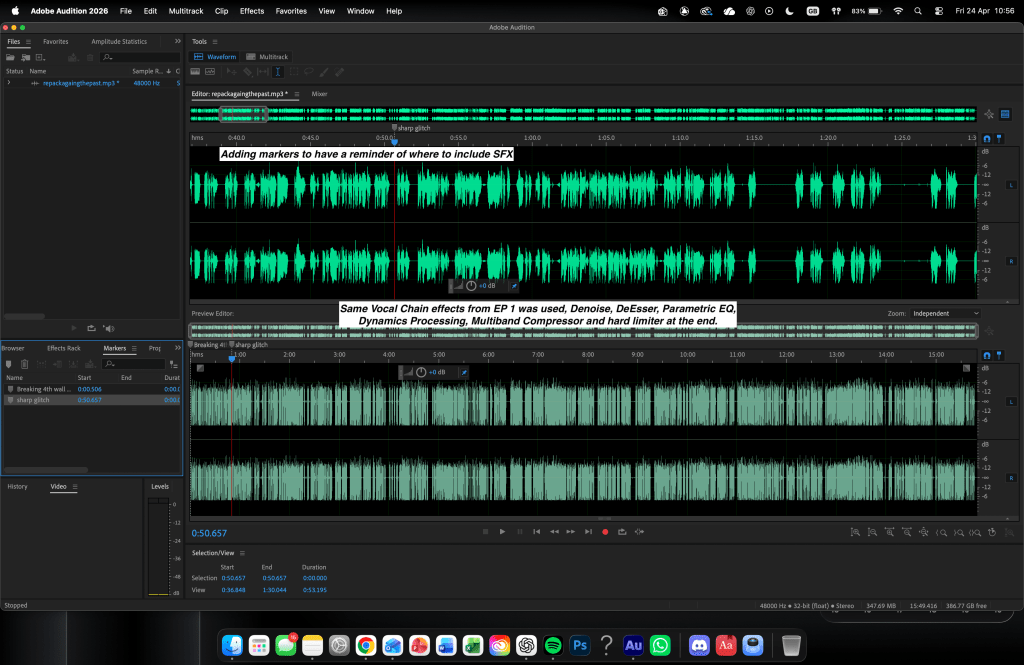
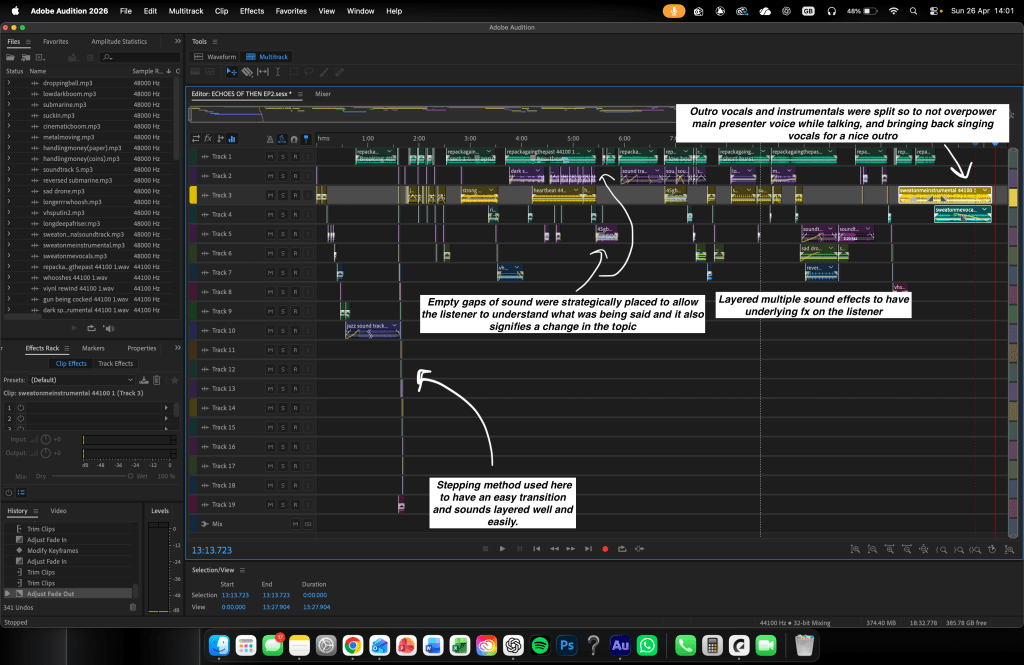
All annoted screenshots are shown below
The narration was recorded in a treated environment and edited using Adobe Audition on my MacBook Pro M2. I used the same vocal processing chain as Episode 1 to maintain consistency across the series. This included:
DeNoise
De-Esser
Parametric EQ
Dynamics Processing
Multiband Compressor
Hard Limiter
Practical Skills
I completed the full scripting, recording and editing of Episode 2, while also developing more advanced sound design techniques.
A key skill I developed was manipulating the listener’s expectations through audio. This included:
Creating a false sense of security using music before disrupting it
Repeating and glitching dialogue to simulate audio corruption
Cutting audio abruptly to create tension
Using silence and empty space strategically to emphasise key moments
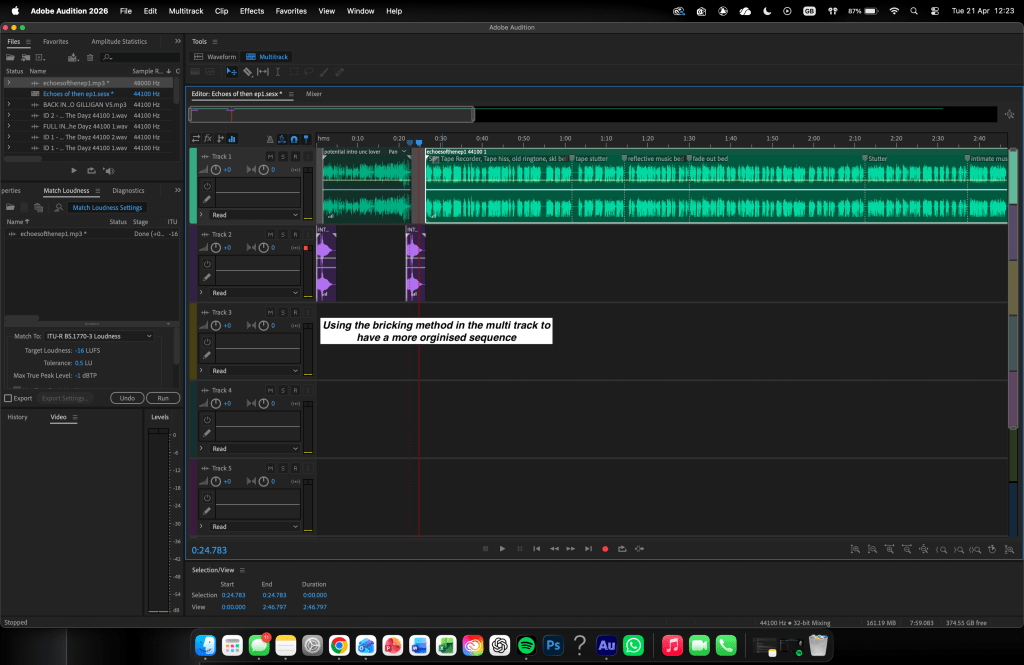
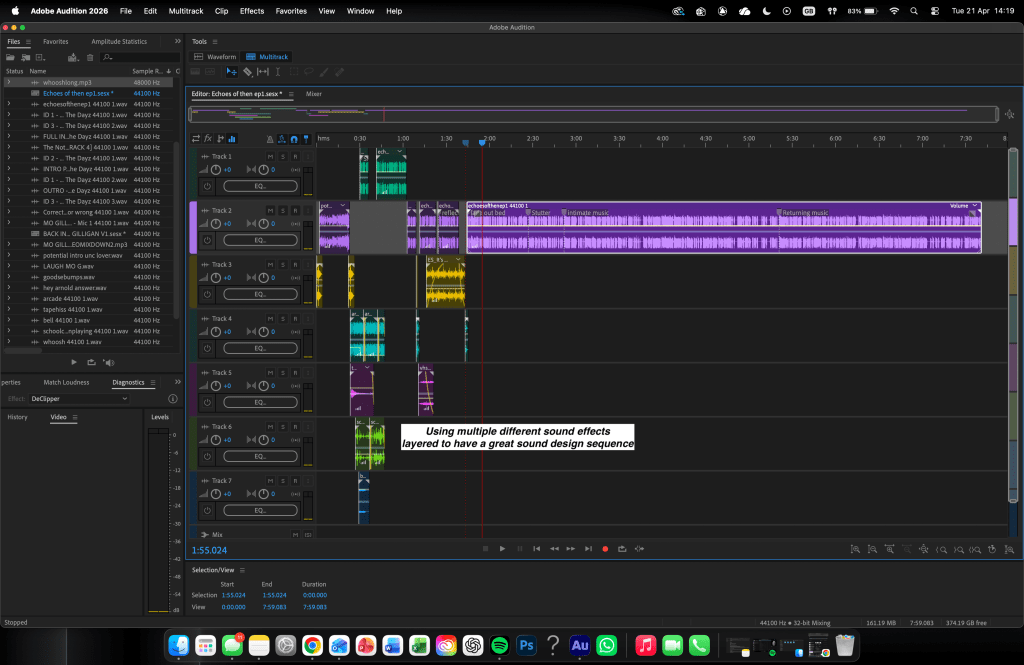
I also continued using bricking and stepping methods within the multitrack to organise the session and layer multiple sound effects effectively. This was particularly important due to the increased complexity of this episode compared to Episode 1.
Volume automation and fades were used more precisely to control how sounds entered and exited, ensuring that the narration remained the focus while still allowing the sound design to have impact.
Evaluation and Reflection
What Went Well (WWW)
1. The episode successfully developed the project’s narrative. Episode 2 clearly builds on Episode 1 by shifting from emotional reflection to critical analysis. This progression makes the overall documentary feel more structured and purposeful.
2. The sound design became more creative and impactful. The use of glitches, repetition and abrupt transitions helped create a more immersive and thought-provoking listening experience. It also reinforced the core theme of manipulation within nostalgia.
3. The editing structure was well organised despite increased complexity. Using markers, bricking and stepping methods helped manage a much more detailed multitrack session, making the workflow more controlled and efficient.
Even Better If (EBI)
1. Some transitions could be refined further. While the disruptive style worked well, a few transitions could be smoothed slightly to maintain clarity without losing impact.
2. The balance between narration and effects could be improved in places. At certain points, sound effects compete slightly with the vocal. Further fine-tuning would ensure the narration always remains dominant.
3. Planning sound design earlier could improve efficiency. Although experimentation led to strong creative outcomes, pre-planning certain sound design sections could reduce editing time while maintaining quality.
A link to this episode will be attached when the series is complete
For this week on the FMP, my main focus was moving on from the previous research page into the first stage of production, writing, recording and editing my first episode for the project being, “Why do we miss the past?” The aim of this episode was to bring in the theme of nostagia, and help the listneer understand what the feeling actually is. Making sure to tailor it to my primairy audience of 16-24 yer olds with a secodary audience of 25 – 36 years old.
Research
Story
This week the main priorty was making sure the script was completed which is now in the practical skills section of my website. And also making sure the theme was properly introduced and answering the main question. I wanted the episode to feel reflective, informarive while still sounding natural and easy to follow.
The script and the recording had to establish Echoes of then ads a concept and also act as a strong opening to the three part series.
Stylistically, this week ws about making sure Episode one had the right atmosphere. Taking a lot of the sound design techniques from a previous audio documentary mini series of mine, The playbook, mainly the first installment The revival of british basketball.
I wanted the tone to feel calm, reflective and layered so that the audience could properly understand the rmotional side of nostalgia before flipping the script in later episodes to show them a more anylitical side. I used a mixture of narration, ambient sound design, old school effects and music beds to make the episode feel more immersive rather than simple spoken all of the way through.
Technical
The tehcnical focus was making sure my main vocal was serisouly on point along with all of the other effects. I recorded the narration in a treated space and editied the episode on Adobe Audition on my Macbook Pro M2 . I used a full vocal processing chain, all of the screenshots of the process has been attached below. This was all to improve clarity and includes the, De-Esser, Parametric EQ, Dynamics Processing, Hard limiter and the multiband compressor.
Practical Skills
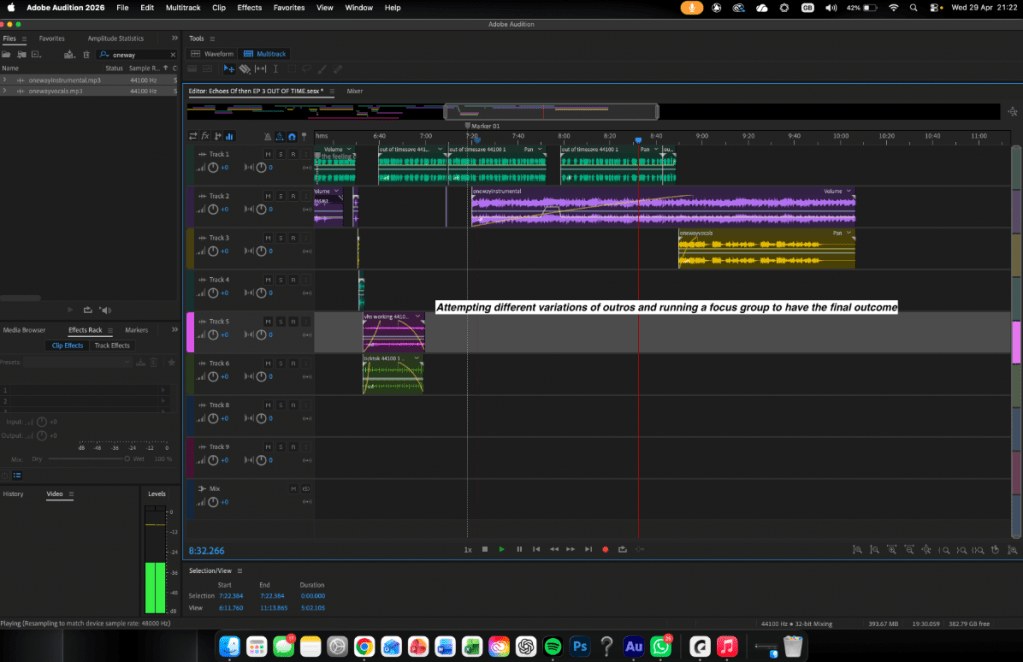
The skills this week were fully based around production and post production. I first scripted the entire episode then recorded and edited the final peice. In the intro I ran a focus group too to help me select a specific sound track for the intro.
Below I have attached the 3 options to focus group could choose from, for context, I wanted to evoke a warmth feeling alongisde nostalgia etc. The group selected the second one which I did agree with.
I further used techniques such as bricking and stepping to keep the session irginised, layered with so many different sound FX. This was all to create a powerful opener to the series. I also adjusted fades and volume automation to make key moments so much more effective.
Evaluation and Reflection
What Went Well (WWW)
1. The script translated well into the final documentary. The script gave the episode a clear structure and made it easier to build a professional documentary flow. The final piece stayed close to the original intention and successfully introduced the topic of nostalgia in a calm and reflective way.
2. The vocal processing improved the quality of the narration. Using the de-esser, EQ, dynamics processing, multiband compression and hard limiter helped make the narration cleaner, clearer and more consistent. This gave the episode a stronger overall finish and made it sound more polished.
3. The sound design and multitrack structure were effective. Layering multiple sound effects, music beds and transitions helped the episode feel immersive and well-produced. The use of markers, bricking and stepping in the multitrack also kept the editing process organised and easier to manage.
Even Better If (EBI)
EBI (Even Better If)
1. The editing process could be made slightly quicker. Although the final outcome was strong, some of the editing took longer than expected because of how detailed the layering and refinement became. In future episodes, I could make this process more efficient by preparing the track layout earlier.
2. Some sound effects could be refined even further. While the sound design worked well overall, a few effects and transitions could still be balanced more carefully so that they support the narration without taking too much attention away from it.
3. The vocal chain could be tested earlier in the process. Although the final settings worked well, testing and locking the vocal chain earlier would make the workflow smoother for future episodes and save more time during post-production.
For this week on the FMP my main focus on was on buildinf the research for my project, Echoes of then. The project explores how nostalgia and past memories continnue to influence modern media, audiences and culture. My project has a strong link to the Back in the Dayz Podcast with Stevo the Madman.
In this week I developed the core research segment, my strategy and material I can use within my project. This is majorly important as my project is aimed at a specific audience of 16-25 with no real gender skew and it helps develop it from an initial idea to a more structured based documentary plan.
Research
Story
The main part of my research is all about what Echoes of then is about and who is it actually for. Developing an audience plan by identifying that the core audience would be digitally active who are interested in media, music, nostalgia and podcast culture.
I stregthened the research too through my case study through research into theBack in the Dayz podcast this was useful as the podcast is built around reflection and a shared memory. They are presenting it as a “Trip down memory lane” that makes it directly relevant to my target audience.
Stylistic
My stylistic research is all about what Echoes of then would actually look like and sound like in order to appeal to my target audience. I researched how sucessful audio story telling uses structure, sound and interview material to keep the listeners enganged rather than just one voice all of the way through. Using sources like BBC Academy and Transom.
I also linked this stylistic research to the podcast itself. Elements such as the nostalgic introduction and recogognisable cultural references and humuours moments are all techniques that could help the project appeal to the target audience. I also reflected on my own documentary series “The playbook” not on the content itself but rather on the pacing of it and how I could adapt it to this project.
An example of the content and recognisable sounds etc has been attached as an mp3 below
Technical
My technical setup is based around recording my script in a sound treated space, using an Audio Technica AT 2020 which has a wide frequency range however when in a treated enviorment it preforms very well. I will also be editing the entire project on Adobe audition on my Macbook Pro M2.
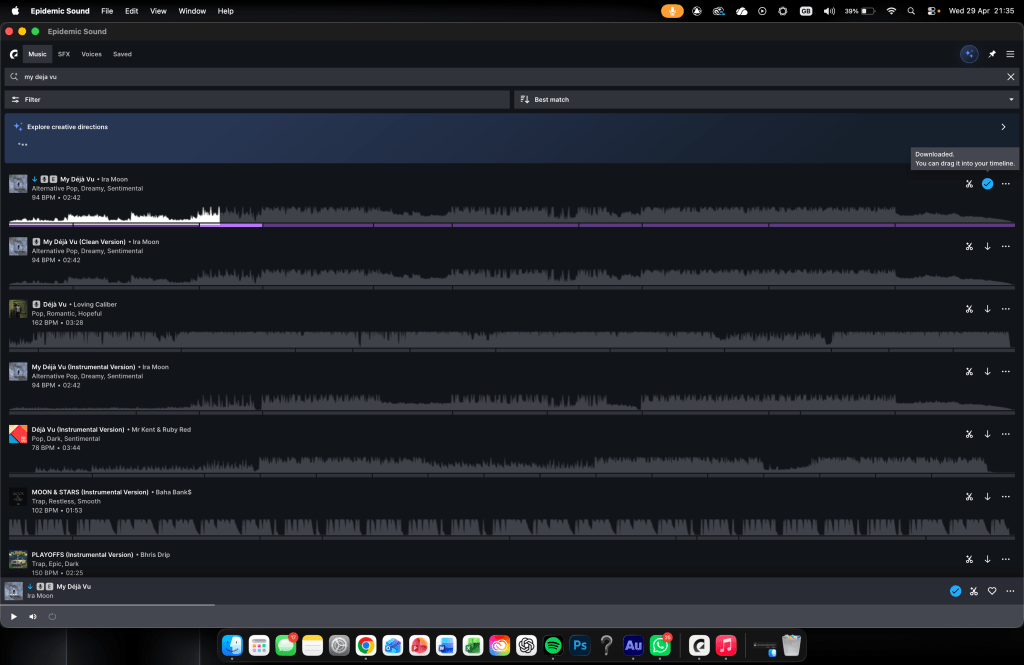
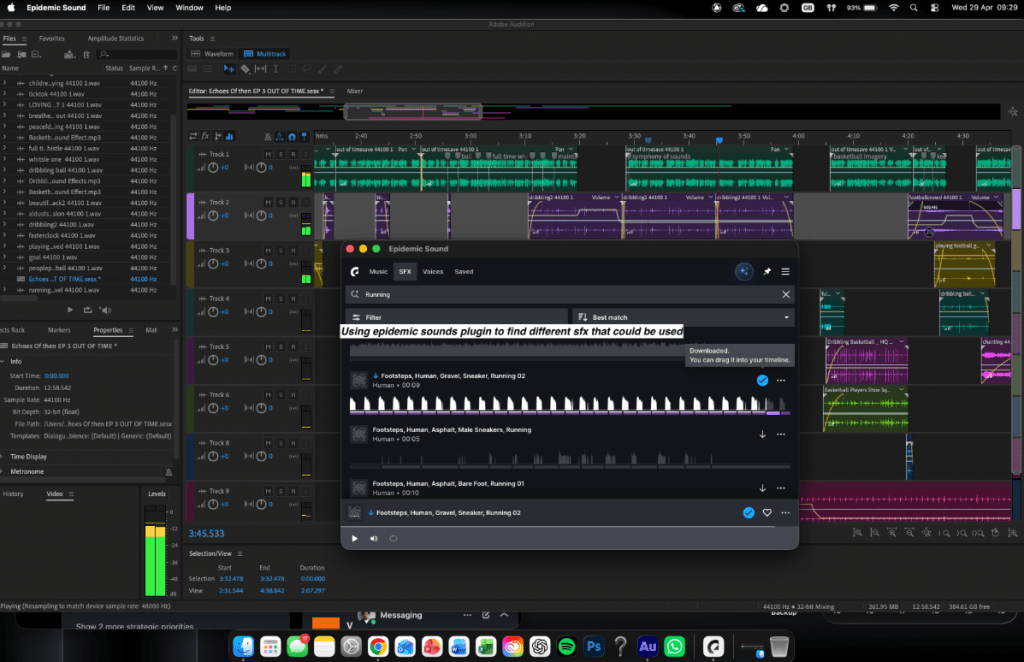
I also looked at Epidemic Sound for a sournce for ambient sounds in the background for FX and assests. It is important as it is a credible professional sournce for audio sourcing.
Practical Skills
My practical skills mainly invloved organising and improving the research presentation on my website rather than beginning my production phase. I built out the research phase that would clear my target audience up nicley. S tronget ink to the back in the dayz podcast.
Evaluation and Reflection
What Went Well (WWW)
1. The research became more focused and audience-led.
This week I made the project more specific by linking multiple research sections back to the same target audience of 16–25 year olds, with a secondary audience of 26–35. This made the project feel more consistent and helped me avoid writing research that was too broad.
2. The case study became more relevant and evidence-based.
By using Back in the Dayz as a central case study and backing it up with Spotify and Apple Podcasts sources, I made the research more grounded and directly connected to my own project.
3. My sources became more credible.
I improved the quality of the research by using official and professional sources for style, audio production and sound design, which makes the report stronger overall.
EBI (Even Better If)
1. I add more direct notes from each source into the research page.
Although I collected strong links, the next improvement is to include more short analytical comments explaining exactly what I learned from each source and how it will influence the final production.
2. I improve the presentation and spelling of the research page.
Some of the writing still needs refining so that it looks more professional, especially in headings, spelling and consistency across the page.
3. I begin linking the research more directly to each of the three episodes.
The research is strong overall, but it would be better if the next stage clearly showed how particular findings will shape Episode 1, Episode 2 and Episode 3 individually.
This week marked the final stage of the 3-week branded content project with Heinz Beanz, culminating in the delivery of the final campaign pitch.
The campaign concept focused on adapting iconic film scenes into trailer-style advertisements, integrating Heinz Flavoured Beanz into recognisable narratives.
During the week, I refined the presentation and produced additional billboard mockups styled as cinematic posters to demonstrate real-world application.
The final pitch was delivered at The Shard, outlining the concept, marketing approach, and visual execution.
The target audience was 18–34-year-olds with an interest in social media and film-based content.
In this project we were tasked with assisting with the promotion of the flavoured Heinz Beanz product. The aim was to target this product towards a younger audience range of around 18–34 year olds, with no specific gender skew.
Our main idea that we settled on was to create parody movie trailers or famous movie scenes and rebrand them to be Heinz related. For example, the famous red pill / blue pill scene from The Matrix would instead feature two different Heinz bean flavours.
During this week, we focused mainly on developing the pitch presentation and refining the campaign concept, including creating visuals and thinking about how the campaign would be distributed and measured.
Research
During this week we researched how film parody advertising campaigns work and why they are effective for younger audiences. Younger audiences often engage more with recognisable pop culture references, especially when they are humorous or unexpected.
We also looked into how social media engagement and shareability plays a role in advertising success. Platforms such as TikTok, Instagram and YouTube Shorts would allow the campaign clips to be easily shared and reposted, helping the idea spread organically.
We also included research and data within our presentation to support the claim that short-form, entertaining content performs well with the 18–34 demographic, making this concept suitable for the product.
Story
The goal of the campaign is to create recognisable, entertaining and shareable movie scene parodies that promote the new Heinz flavoured Beanz range.
These scenes would recreate iconic moments from popular films but with a humorous Heinz twist. For example:
A Mission Impossible style scene where someone attempts to steal a rare tin of flavoured Beanz
A Breaking Bad parody where the new bean flavours replace the original product
A Hunger Games style visual where competitors fight over different flavours
These scenes would be turned into short trailers, social media clips and billboard visuals, helping the product feel more culturally relevant to younger audiences.
We developed our main presentation format this week which outlines the campaign concept, target audience, distribution platforms and how success would be measured.
Pitch deck:
Stylistic
Our main stylistic inspiration came from parody advertisements that recreate famous scenes but rewrite the dialogue and product placement to promote a brand.
One key example was this Breaking Bad parody advert, where the famous scene was recreated and rewritten to promote the snack product. The humour and recognisability of the scene made the advertisement entertaining while still clearly showcasing the product.
This approach inspired us to ensure that our parody scenes would still feel recognisable, but rewritten to highlight the Heinz Beanz flavours in a humorous way.
Technical
Since this project is primarily a pitch concept rather than a produced advertisement, we did not use technical filming equipment.
However, we did use several digital tools to develop the campaign idea including:
Canva for creating the pitch deck and visual campaign examples
Image editing tools to create mock billboard concepts and visuals
Online research sources to gather marketing data and audience insights
These tools helped us visually communicate how the campaign would look if it were produced.
Practical Skills
This week we focused on turning our core idea into a structured pitch presentation.
We expanded on the original mind map and developed a clear slide-by-slide presentation, including:
The campaign concept
Target audience
Advertising platforms
Visual examples of the parody scenes
How success would be measured (sales increases, engagement and shares)
We also created mock visuals such as billboards and promotional images, which helped bring the concept to life and made the pitch more engaging.
WWW (What Went Well)
1. The concept was developed further
This week we were able to expand the original parody idea into multiple scene concepts and campaign visuals, making the idea feel more realistic and achievable.
2. The presentation became much clearer
We organised the pitch deck so that the campaign idea, audience and marketing strategy were clearly explained, which helped make the overall concept easier to understand.
3. Strong visual examples
Creating mock visuals and parody examples helped demonstrate exactly how the campaign would look in real life, making the pitch more engaging.
EBI (Even Better If)
1. More time for refining visuals
Although we created several visual examples, having more time would allow us to improve the designs further and create additional scene ideas.
2. More detailed audience research
While we did research the 18–34 demographic, it could be improved by including more detailed statistics or consumer behaviour data.
3. Testing the idea with a small audience
It would have been useful to gather feedback from a small focus group within the target audience to see how they react to the parody concept before pitching it.
In this project we were tasked with assisting with the promotion off the flavoured Heinz beanz product. The aim was to target this product too a younger audience range to around 18 – 34 year olds with no real gender skew at it.
Our main idea thart we settled with was to create a parody movie trailer/famous movie scene and rebrand it to be heinz related. For example the matrix red pill blue pill scene is 2 different bean flavours.
Research
Story
As stated previously the goal here was to create a recognisable, entertaining and shareable movie scene rebranded (without infringing on copyright laws) to engage viewers and make the heinz beanz flavours more noticed in the wider markert, more in with the younger generation.
We did this by laying out our main presentation format of what we would be doing and how will be doing it. Coupled with our data as well
Stylistic
Our main inspiration for this would be this scene recreation by poppers using a famous scene from breaking bad, which is linked below. The product placement is everywhere and also the wording of the scene was accuratley rewritten to show how great the poppers where to show them to be an excellent choice for a snack
Technical
In terms of this wider project we would not use any technical equipment as we are just presenting an idea to heinz as the company.
Practical Skills
We started by creating a mindmap of our ideas to do with the film parody idea which is shown below to accuratley represent all of our ideas on one paper. We then represented the broader ideas all on a presentation powerpoint shown above as well. This in turn helped lay out ideas in a great presentation and effectivley too.
WWW (What Went Well)
1. The planning
We collected all of the neccacey data, gender skews, age ranges and focus groups to accuratley determine whether this idea would be good or not.
2. We presented our ideas effectivley and effeicently
Using the mindmap really helped out lay out our main ideas for this project.
3. The main idea was unique but useful.
The main idea of a film parody really helps in the sense that it would create for a recognisable yet enetertaing advertisment that could also be shareable causing the general target audience to talk about it as well.
EBI (Even Better If)
1. Timings
It could’ve been better of we made our ideas and oresentations much more quicker as we would have more time to think about what the presentation looms like rather than worry about all of the info.
2. Maybe a better idea could’ve been selected
We also discussed having a cook off showcasing different styles of cooking with the flavoured baked beanz however we settled on the film parody.
3. Stronger audience alignment
Maybe a wider audience age range could have been selected to have a broader reach within the younger age range
The framing of the interview largely follows the rule of thirds, with the subject positioned slightly off-centre rather than directly in the middle. The eyeline sits near the upper third of the frame, which keeps the audience visually engaged. As spoken about in the 4 essentials video linked below.
Headroom is controlled effectively. The subject does not appear cramped at the top of the frame, and there is enough space above the head to maintain balance without creating excessive negative space.
The framing feels balanced in relation to the mannequins placed within the set. The mannequins act as visual anchors on either side, preventing the shot from feeling empty while reinforcing the sports theme.
There are no major examples of distracting “background growth” (e.g., objects appearing to come out of the subject’s head). The background elements are positioned slightly off-axis to maintain clean separation.
Lighting and Contrast
The lighting, which was mainly the pixapro flood light, was adapted to create separation between the subject and the props and to also evenly light the subject in place to even out the enviorment and make for a nice, clean and professional set.
Exposure is well managed. The fabrics of the kits for example in the one person shoot video retain visible texture and detail, rather than appearing blown out or overly dark. Skin tones remain natural, which supports the professional aesthetic.
Shadows are controlled carefully. While there is enough shadow to create dimension, they do not obscure the interviewee’s face. The face remains the brightest and most visually dominant element in the frame, ensuring audience focus stays where intended.
Scene Dressing and Depth
The mannequins are placed strategically to create layered depth. There is a clear foreground (interviewer framing), mid-ground (interviewee), and background (sports kits/mannequins). This layering gives the shot a three-dimensional feel.
The sports kits are clearly visible, immediately communicating the sports interview theme. This supports audience understanding without requiring verbal explanation.
The set dressing appears organised and deliberate rather than cluttered. Each prop serves a purpose, contributing to brand identity and reinforcing the sporting context.
The subject is physically separated from the background elements, which enhances the 3D effect. This spatial separation prevents the frame from feeling compressed and improves visual clarity.
All of this is particulary shown in the one person shoot video linked below.
Multi-Cam Editing Best Practice
In my floor plans, here and here I try to accuractley display the shots and the type of angles I want to aim for. Hence for labelling my cameras as such.
The M-Cam (wide shot) effectively establishes the relationship between the interviewer and interviewee within the dressed environment. It contextualises the conversation and showcases the set design.
The R-Cam (close-up) captures emotional detail and subtle facial expressions. This makes the interview feel more personal and immersive, allowing the audience to connect with the subject.
Colour grading and lighting are consistent between both cameras. The match prevents jarring transitions and maintains professional continuity.
All of the uploaded edits of the multi cam videos and everything else mentioned will be here

 Imad Daili - Sports Media